Chapter 918: The Dragon and the Human
Turn off the lights to protect your eyes, large/medium/small
Confirming player race and faction...
Setting up the board...
After confirming her choice, Dorothy's consciousness was ejected from that chaotic world.
The Zhaimonv returned to reality; she blinked and once again saw her sisters beside her, and across from her, the Rock Mountain Dragon Witch, whose hand still rested on the board.
"Master Guiguzi, why did you choose humans?"
Estelle also snapped back to awareness; she frowned, then asked with some confusion.
Humans are the weakest race on her war board—so weak, in fact, that humans were never originally intended as a selectable faction at all.
They are a resource race of this world.
You can treat them as decorative elements to show the world's vitality, as wild monsters for leveling up, or as conscriptable Pucongjun and easy labor.
In short, their status is utterly lowly.
Well, in reality, humans are treated much the same— as a black iron race, they're just too ordinary, even among all black iron races, they're the most unremarkable.
After all, their reproduction rate is inferior to goblins, their magical affinity worse than slimes, their physical strength below half-orcs, and their mental resilience less than ghosts.
At first glance, they seem highly advanced—possessing body, soul, and mind—but in truth, all three are weak, so mediocre they're painful to behold.
Though these weak creatures always boast themselves as intelligent beings, proud of their wit, from the perspective of transcendent races, humans are no different from humans watching monkeys.
Their minds are truly primitive—some petty cleverness, but not much.
After all, a race whose brain lacks even a magical command system, relying solely on rare genetic mutations among a few individuals, cannot be called truly intelligent.
A race that can't even qualify to enter the Diantang of magic is merely a slightly smarter monkey—their intelligence is only human-level.
If you must find a human advantage, it's only their resemblance to higher races in appearance and their terrifying adaptability.
Though they're mediocre in every way, they're decent at everything, with no glaring weaknesses—so in any world, as long as basic biological survival conditions exist, you'll always find humans, like the "cockroaches" of the world, their vitality unnervingly resilient.
Thus, some scholars believe that if the world was created by gods, then humans are the gods' "statues," molded in their own image—just as people decorate their rooms with statues and photos, gods use humans to adorn their created worlds.
At least with human activity, those worlds won't be too lifeless.
This "decorative object" theory is widely accepted by the vast majority of transcendent races in the Western Universe, so most of these races look down on humans—after all, transcendent races are children of the gods, the masters of the house, far nobler than mere decorations.
So play freely, build freely—humans are cheaper than weeds; if you break them, they'll just regrow after a while.
Of course, in the witch world, ordinary humans are treated far better, since witches are an evolved subspecies of humans—close relatives.
But this kinship has gradually grown distant as the witch race has evolved and the Primordial Witches have withdrawn from the world.
After all, visiting relatives is mostly an old-generation habit; the younger generation rarely cares...
You can't expect these newborn witch girls, born as superhumans, to feel close to humans—they've never lived as humans like the Primordial Witches did. To young witches, witches and humans are two distinct races, even if witches originated from humans; their current superiority over humans is undeniable.
Still, overall, due to that ancestral bond, witches remain generally friendly toward ordinary races.
Estelle, though thousands of years old, is still a young witch by witch history standards; toward this relative, she neither particularly likes nor strongly dislikes humans.
So she won't randomly slaughter them, but she won't go out of her way to favor them either—she mostly just doesn't care.
The humans in her board world weren't placed by her—they were native inhabitants before she conquered this great world. When she turned it into a war board, she didn't bother altering these mortals, since in her view, weak humans weren't even worthy of being chess pieces.
Yet, over time, as she repeatedly used this board for war games, and as powerful factions repeatedly launched wars that swept across the entire world, the humans on the board somehow kept clinging to life, never going extinct.
The nickname "world cockroach" was no accident—their vitality is truly resilient.
Even amid this desperate survival in the cracks of war, humans produced numerous hero units. One day, while performing routine maintenance on the board, Estelle was stunned to discover that the number of human heroes had grown enough to form a full faction.
So the Rock Mountain Dragon Witch casually elevated humans to a selectable faction—but honestly, this war board has been in her hands for centuries, and she and her friends have played countless games, yet players who choose humans are exceedingly rare.
A few self-proclaimed experts tried to show off, claiming they'd win with the weakest against the strongest, deliberately picking humans—only to be crushed. Brutal reality taught them what "mud cannot be raised to the level of jade" means.
While everyone else rides dragons, your human infantry—what are you going to fight with? A few dragon flights and aerial breath attacks are enough to vaporize your hard-earned tens of thousands of troops.
What's the point? This trash tier is unplayable.
Now, the girl across from her seems to have made the same mistake as those pretentious friends of hers.
Of course, Estelle still respects Master Guiguzi as her idol of military genius, so she didn't rashly label the girl's choice as pretentious—but she truly couldn't understand why anyone would pick humans.
What, are you going to emulate the Divine King and lead a horde of mortals to crush the Catastrophe Armies?
Even the most devoted fan of the Rock Mountain Dragon Witch wouldn't dare claim a mere military genius could rival the Three Kings.
Besides, the Divine King back then directly elevated mortals into witches through his own bloodline—what kind of military strategy is that? In the game, it's just two words: cheater.
He literally used a cheat engine, completely ignoring the rules.
So it's not that she disrespects Master Guiguzi—it's just that using mortals against Catastrophe races has no chance of victory. If anyone could actually accomplish such an absurd feat, they'd surpass even the Divine King.
Turn off the lights to protect your eyes, large/medium/small
But is that possible?
Completely impossible.
In all these years in the Western Universe, only one Divine King has emerged; the Catastrophe races have added only one new anomaly besides the old three—the witch.
"Master Guiguzi, I just picked the Dragon race. Why don't we restart?"
Estelle suggested.
She craved a balanced battle, one that would make her brain boil with calculation—not a boring, one-sided massacre.
Honestly, even if you want to win with the weak, pick goblins or slimes—they may be weak, but their racial traits are notable, and they've actually created miracles of overcoming the strong before.
"No need. Leave it as is. Rather than worrying about me, focus on your tactics—otherwise, I fear you won't last thirty minutes."
Across from her, the Zhaimonv waved her hand, her face wearing a rabbit-like innocent expression, yet her words were shockingly arrogant.
Estelle: "......"
Master Guiguzi, even a fanatic has pride. If you say that, I won't hold back.
The Rock Mountain Dragon Witch thought, slightly angry.
Even if the opponent is her idol, even if she truly feels inferior, she still has dignity—no one stays calm when so belittled, especially not a Dragon Witch with a fiery temper.
"This game, I'll make you surrender in fifteen turns."
Estelle silently resolved.
She was confident.
After all, dragons are her usual race—though dragon hatchlings grow slowly, time on the board differs from reality: ten years on the board equals one minute in reality.
That is, ten years in the game equals one minute in the real world.
Fifteen minutes equals one hundred fifty years—plenty of time for hatchlings to mature into young dragons. Then, a swarm of dragons attacking a human kingdom that's only developed for 150 years? Easy victory.
After all, what can a human kingdom of just 150 years achieve? Even magic kingdoms that have lasted thousands of years struggle to withstand dragon assaults—only a tiny fraction of humans have magical talent, and 150 years isn't enough to train even a handful of mages, let alone raise them to dragon-slaying levels.
In short, I've already won.
Dorothy naturally noticed Estelle was slightly annoyed, but in her Moon Goddess state, she Landeduoshuo.
No matter how much she explained, it wouldn't compare to a single battle—then Estelle would realize she wasn't boasting or belittling her; she was simply stating facts.
How to overthrow Catastrophes with mortal flesh—she had already achieved this in her dream during the Witch Night. It's not impossible.
Besides, in the rules of this war board, both sides start from the same point.
She begins with one human tribe; the opponent begins with one clutch of dragon eggs. Compared to facing Gaibellis, the strongest Angel King, during Witch Night, this pressure is nothing.
So the Zhaimonv simply watched the game board quietly.
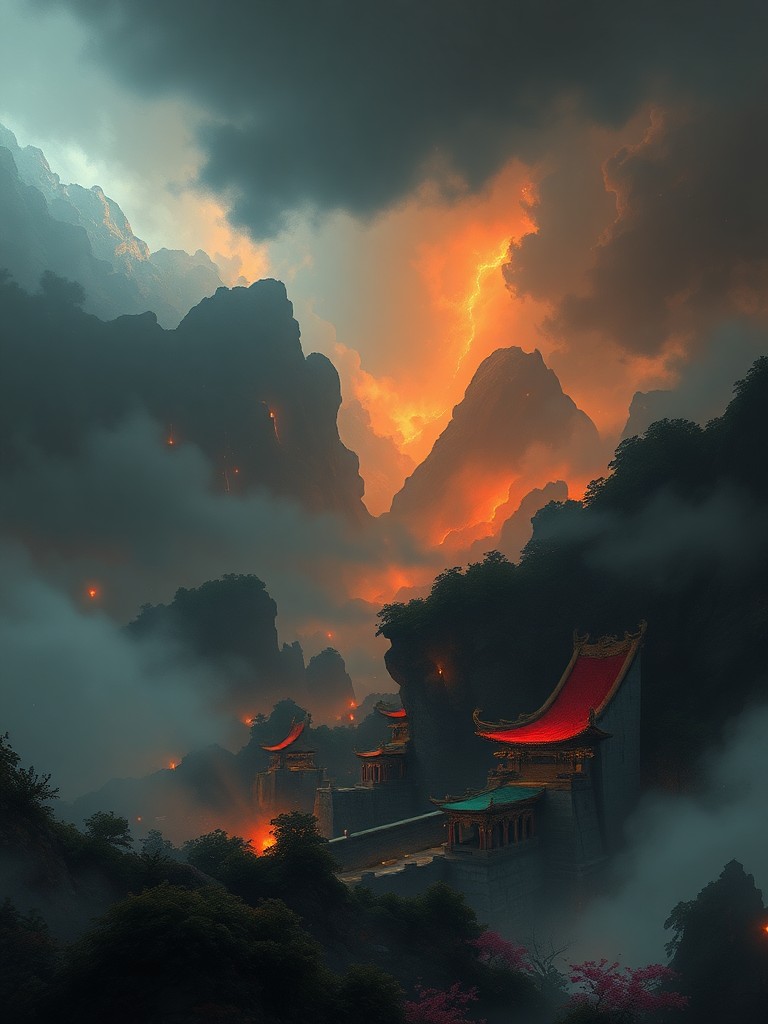
The so-called board setup isn't like an arena's empty creation—this board is a real, vast world.
But the board's rules are the world's heavenly principles—or fate itself. As the game begins, fate activates, guiding the world, everything accelerating as if a speed button was pressed, moving toward its destined path.
Dorothy and the others, observing from outside the board, witnessed the world's evolution.
She saw the rise and fall of many races, watched the fall of a once-prosperous human magic kingdom, saw its survivors forced to flee to the frozen northern wastes, barely clinging to life.
She also witnessed dragon infighting—a massive dragon fled with a clutch of eggs, finally crashing into the sea; its body became a great mountain, while the eggs absorbed magic, waiting to hatch.
Soon, the human survivors formed a small tribe on the cruel ice plain. To stabilize morale, the young chieftain decided to hold a divine prayer ceremony.
Meanwhile, on the dragon corpse island, the clutch of eggs began to tremble, cracks appearing on their hard shells.
The match begins...
"Great deity, we offer you sacrifices, begging you to show mercy and protect our tribe through this freezing winter."
In the night sky, the bright moon hung high, like a cold divine eye gazing down upon the earth.
Amid the snowy wasteland, within the broken tribe, the young chieftain and her people danced around a bonfire—the only legacy left by their ancestors.
Whether this prayer dance could truly summon divine mercy, the young chieftain Elsha didn't know—but if it calmed her people, even a little, it was worth it. At worst, dancing around the fire would warm their bodies—so it wasn't wasted.
Yet as their dance reached its climax, the central bonfire suddenly erupted with a crackling sound, flames surging upward like a pillar straight into the sky.
Above, the full moon cast down a beam of light, merging with the fire pillar—a deity emerged from the light and flame.
She was a goddess of beauty beyond description: rabbit-like ears atop her head, four pure white wings spread from her waist, moonlight and flame flowing like ribbons behind her, entwining her wings and arms, radiating divine splendor.
The goddess was tall and voluptuous, nearly as tall as the tribe's tallest warrior, her maternal, graceful features combining strength and beauty—she radiated instant reassurance.
The only odd thing? Such a holy goddess held no staff or sacred sword—only an ordinary hammer in her hand.
"Oh my, it really manifested!"
Elsha blinked in shock, forgetting her dance. Fortunately, the elder women beside her remained alert; they grabbed her clothes and pushed her head down, urging her to kneel.
But their knees never touched the ground.
The goddess born of light and flame opened her eyes and spoke her first divine utterance.
"Stand. Do not kneel."
... Moon Goddess manifests...
End of Chapter