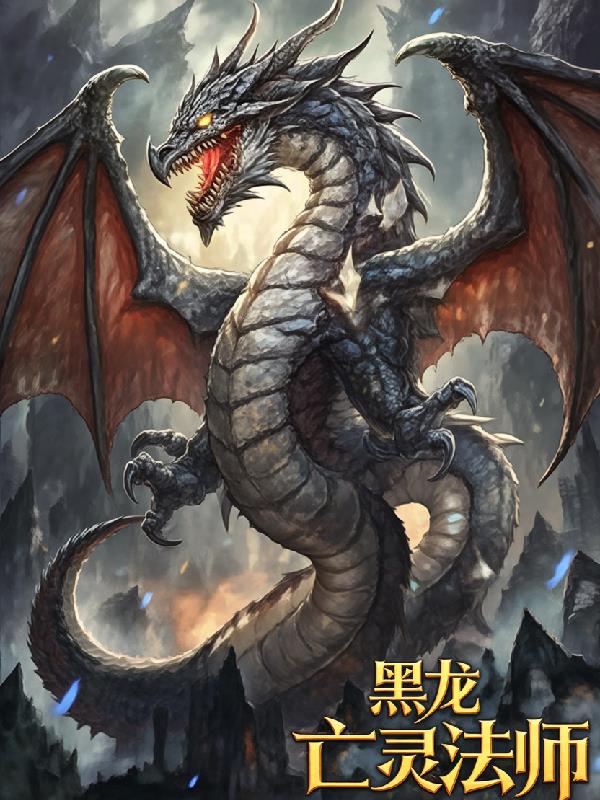
Chapter 39: Wings of the Black Dragon
Su Lai De, who returned from the Ainoiteer plane, gave Sakavi a letter from the Obsidian Dragon. After reading the letter, Sakavi was puzzled, because it only had two words written on it: "So stupid."
Sakavi asked Su Lai De what he said to that Gem Dragon, and the answer he got was that he didn't have time to say anything. The Obsidian Dragon dropped the letter and left, also saying that if he dared to lose the letter, he would twist off his and Vilna's heads. The two hadn't reacted yet when he had already flown far away.
The Obsidian Dragon just likes to fight, not to tease people. Sakavi thought that since he said he was very stupid, there must be a point. Sakavi carefully checked the various components of the letter and found no problems. With no other choice, he called Su Lai De over to ask.
This question really got the answer. Su Lai De said that there was an extra memory in his brain that didn't belong to him. To be precise, he had clearly been to a wilderness in Ainoiteer, but he inexplicably knew the entire terrain.
Combined with the Obsidian Dragon's ability to extract other people's memories, Sakavi thought this was the Obsidian Dragon deliberately pressing someone else's memory into Su Lai De's brain. Then what was the thing he wanted to tell him?
Soul, memory, mental power, arrogance—arranging all the characteristics of the Obsidian Dragon together and repeatedly deducing, Sakavi finally knew what he wanted to express.
This was through reading the subordinate's memory, knowing all of Sakavi's behaviors in the Red Moon plane, and then mocking the obstacles Sakavi encountered when studying soul strength. Then what was the guidance he wanted to give?
Sakavi, who really couldn't figure it out, could only call Su Lai De again and thoroughly check his soul, only to find that his soul had not been embedded with any memory by anyone, but had been transferred to an incomplete soul.
Sakavi suddenly realized that this was telling himself that incomplete souls can be transferred and can also be sealed in biological bodies to avoid plane disturbances. As for how to transfer and how to seal them in the body, that depends on his own exploration.
But this is contradictory. Transcendent creatures or intelligent creatures without souls are not tolerated by the gods and planes, and incomplete souls cannot withstand plane disturbances. Complete souls cannot be created yet. Isn't this completely blocked? And the Obsidian Dragon doesn't say how to solve this problem.
However, since he said it, there must be a solution, and it is still in the necromancy field that Sakavi is good at. Although the Obsidian Dragon is arrogant and irritable, he is definitely not stupid. Sakavi met this existence once. At that time, he said that he was all black-skinned, and this face must be given. The pressure when he laughed made Sakavi unable to lift his head.
In terms of necromancy, the only thing that can firmly fix a soul in a container is the Sealing Technique. Not many people know this relatively unpopular spell. It is mainly useless for fighting, unless it is those particularly large forces that specifically cultivate people in this area to seal some demons that are difficult to kill.
Do it as you say. Although the Sealing Technique is unpopular, it doesn't mean Sakavi can't get books in this area. The Eye of the Curtain has already infiltrated 20 nearby planes. There are ways to get the Sealing Technique. Currently, Vilna hasn't returned, so he can only order the Deputy Superintendent, Ulnuo Mud, who is the second-generation descendant of the 30 Bog-men who followed Lap to the Red Moon plane back then.
Ulnuo did not live up to expectations and brought back several bloody Sealing Technique books a month later, from basic to advanced. The efficiency of handling things is indeed no problem, it's just that the method is a bit rough. Sakavi has always only cared about the results; how to do it is the subordinate's business. If people are managed too strictly, the enthusiasm of internal personnel will become very poor.
Sealing a soul into a container is not difficult; the difficulty is how to use an intelligent creature as a container, and after sealing, this soul can still exert various influences on the container without interference. Sakavi's experiments have always paid attention to first explaining it theoretically, then supplementing the details, conducting experimental verification, and then supplementing the details.
Theoretically, souls can be extracted, transformed, and integrated into new bodies. This is described in detail in necromancy, and Sakavi has also manufactured and transformed incomplete souls. In terms of the Sealing Technique, Sakavi has never found a method that can directly exert influence on biological bodies.
However, since it is impossible to directly exert influence on biological bodies, can it exert influence on containers? For example, a puppet. Since there is no record in the Sealing Technique, it doesn't mean it's theoretically unfeasible. You have to try it in practice to know.
Sakavi remade 500 Death Knights, divided into 10 groups, and sealed them into souls of different completeness. The results of the confrontation experiment showed that the higher the completeness of the soul, the stronger the actual combat strength. However, no matter which one, it could not fight against warriors of the same level, which shows that the experimental theory is not feasible.
After three years of repeated trial and error, Sakavi discovered an interesting phenomenon: sealing an incomplete soul into the body of a bat beast can make the plane no longer reject them. Since this method can be used to drill loopholes in the plane, then if a flesh puppet is manufactured, wouldn't it realize the theoretical soul control of the container?
Flesh puppets are not too rare things. Some merchant organizations, in order to satisfy the "special hobbies" of some people, have tried more than once to manufacture these things that only have instinctive reactions. Gods don't even want to look at these creatures that are no different from wild beasts.
However, this is useless to Sakavi. The body strength is not enough, and it cannot be used for combat at all. It seems that he can only develop the requirements himself. There is no thinking ability, and even flesh puppets without biological instincts are directly controlled by the soul. It seems that there is no existing theory to prove it can be done.
With no other choice, Sakavi could only order people to catch 300 Kuo-toa to verify the feasibility of incomplete souls controlling intelligent creatures. Speaking of Kuo-toa, this is a very magical existence, and their madness is such that even gods don't want to have too much contact with them.
Normally speaking, which race dares to create gods themselves? The gods of the Pantheon would be the first to come down and make them physically disappear, to the point where not even their souls are left. Kuo-toa are perhaps too crazy. Apart from the Mind Flayer race, no one wants to enslave them, whether it is gods or various forces in the Underworld.
Hidden beneath the crazy appearance is extraordinary wisdom. They not only have a strict social organizational structure, an army with abnormally strong combat power, and weird buildings full of organic beauty, but also abnormally strong mental illusions. They occasionally trade with Grey Dwarves, but they never form alliances with any party.
For this kind of untamable race, Sakavi has always used them as consumables, but their souls are abnormally chaotic and not as easy to use as the incomplete souls he created himself. Unfortunately, this experiment was equally unsuccessful. Perhaps the soul Sakavi created was too rational, causing the Kuo-toa to die on the spot every time.
Realizing that direct control doesn't work, Sakavi began to try whether the soul could be sealed into the Kuo-toa body. In this experiment, Sakavi discovered an interesting thing: an accident caused the Kuo-toa to lose a leg. Since the leg can be pulled off directly through the Sealing Technique, what if he deliberately manufactures this kind of Sealing Technique?
Sakavi felt that this was a very good research direction and could try to manufacture small, instantaneous Sealing Techniques specifically used to seal a certain body part of others. However, the current task is still to manufacture complete flesh puppets. Sakavi tried again to seal the entire brain of the Kuo-toa and coordinate various internal body reactions through soul control, but because the soul's calculation level was too poor, the Kuo-toa died directly.
After Sakavi's year-long experiment, he finally manufactured a soul that could replace the brain for internal body regulation. However, Sakavi suddenly found that he didn't seem to need to manufacture such troublesome things. The bodies of intelligent creatures are too complex. Why not just make simple flesh puppets? Why must they be the same as intelligent creatures? No matter how well they are made, they are just used as consumables.
Thinking of this, Sakavi tried to manufacture a batch of flesh puppets with magical affinity. Sealing an incomplete soul into them seems to be usable. If it is a soul that already has spellcasting memory, then after a little practice, wouldn't it be possible to use it as a mage? Gods are so keen on letting their believers return to the kingdom of heaven under their rule—is it for this?
Some necromancers like to plunder souls and manufacture things like Death Knights to serve as their combat power. Sakavi finally washed himself clean and didn't dare to do such things that offend the public. The main thing is that transcendent beings are not Chinese cabbage anywhere, so he had to let his puppets upgrade slowly.
His puppets must have their own characteristics. Sakavi had a flash of inspiration and made them look like black dragon-men, but not the kind that are skinny and skin-and-bones, but muscular, similar to the dragon-men of Red Dragons.
In order to prevent being restrained by others, Sakavi conducted repeated research and created 300 dragon-men covering the seven major professions. It's not that he didn't want to manufacture more, but the soul level he manufactured was too poor, and High-Level was the limit. More would be useless and a waste of resources.
This group of puppets also has to practice repeatedly every day and master the abilities corresponding to their professions, because Sakavi has no channels to get a large number of souls with their own knowledge, so he can only let them realize it themselves.
Sakavi named them "Wings of the Black Dragon," which means the consumables of the Black Dragon, so that they can make the greatest sacrifice for him to fly higher and further. Of course, he can't say that to the outside world. After all, no one wants to be with a boss who treats his subordinates as consumables at any time. ===== CHAPTER 40 =====
End of Chapter