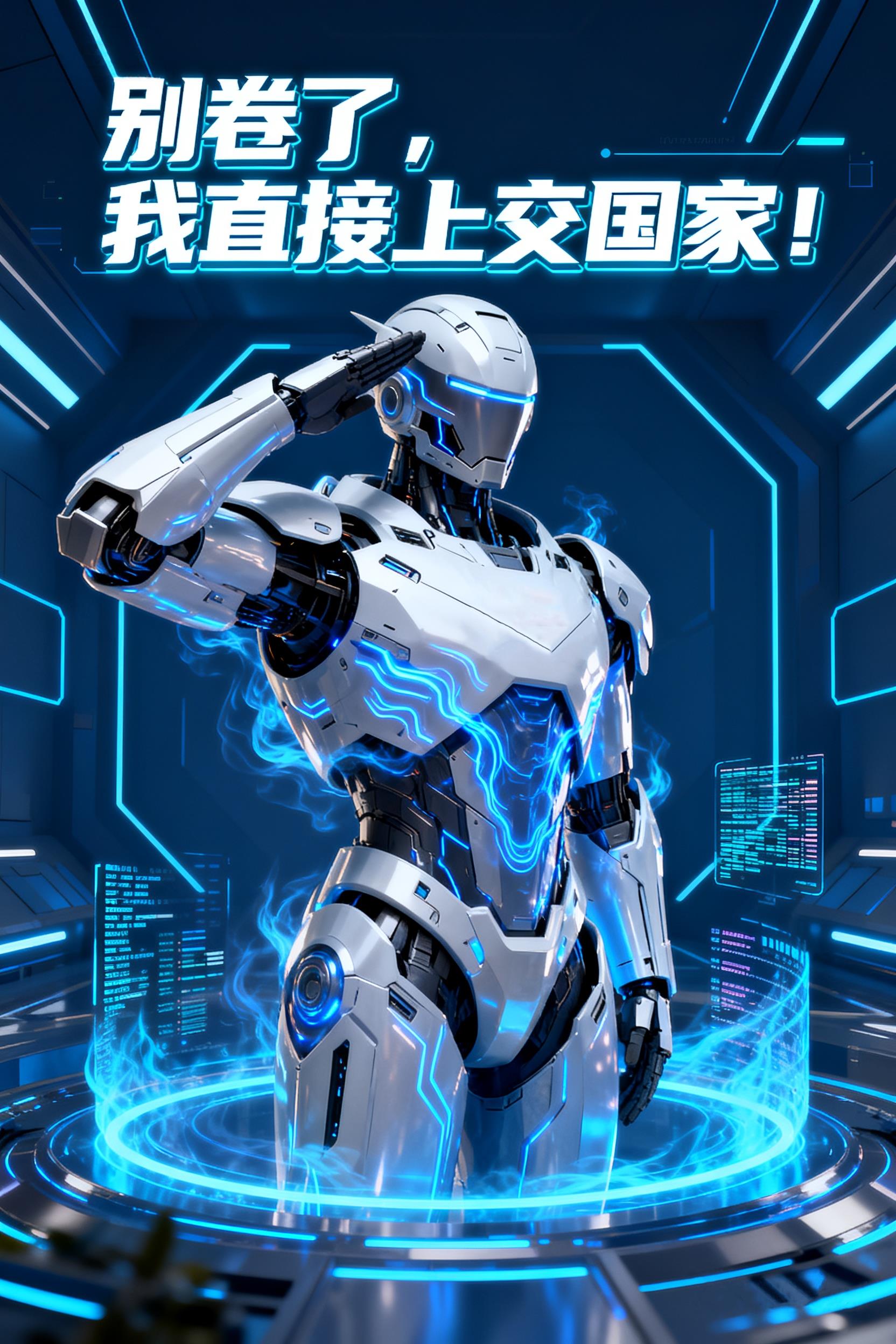
Chapter 127: New Goal—The Ambition of the
The tense situation at the border was like a taut string, and the Longyin Research Institute was suffused with a pre‑battle excitement.
The equipment upgrades, personnel drills, and logistical support were all operating efficiently and orderly.
Yet amid this atmosphere thick with war clouds, Feng Yan's thoughts drifted toward the far‑off starry sky.
During an internal senior meeting, after hearing Li Yang's final report on the "Biyan" mech combat‑readiness upgrade and Wang Hao's briefing on the new reconnaissance payload for the Qingyun‑3 rocket,
Feng Yan then shifted his tone, steering the discussion toward a grander direction.
"Everyone, we must confront the border challenges head‑on and maintain confidence in victory," Feng Yan said, his gaze sweeping over the attendees.
"But at the same time, our vision cannot be limited to the current disputes."
"The low cost and high‑frequency launch capability of the Qingyun rockets, and the increasingly mature space construction and maintenance ability of the Heavenly Clerk arm."
"And the advantages we have accumulated in new materials and AI control give us an unprecedented opportunity."
He paused, then presented an idea that made everyone present gasp:
"I'm wondering whether we could start trying to build a small, experimental… space factory in orbit?"
"Space factory?" Wang Hao's eyes widened to circles.
"Brother Feng, you mean… setting up a branch base in the sky? Doing production?"
"You could put it that way." Feng Yan nodded, pulling up some preliminary schematics.
"It's not the massive industrial workshop people imagine."
"The initial goal is to exploit microgravity, high vacuum, and other special space conditions."
"To produce special materials, high‑purity medicines, or even special semiconductor crystals that are difficult or prohibitively expensive to make on the ground."
Li Yang was immediately drawn to the idea, leaning forward slightly: "In a microgravity environment, material crystallization can be more uniform."
"Container‑free smelting also avoids contamination; in theory it can indeed produce products whose performance far exceeds ground‑level standards."
"Structurally, we can use modular, deployable designs, delivered in batches by Qingyun rockets and assembled in orbit by the Heavenly Clerk arm."
"What about cost?" Zhao Kaiyuan, more concerned with practical issues, asked.
"Although Qingyun reduces launch expenses, building and maintaining a factory in orbit entails significant energy consumption and upkeep costs."
"Therefore the early stage is merely an experimental platform," Feng Yan explained.
"The aim is not massive profit but to verify technical feasibility and seize the high ground of future space manufacturing."
"If successful, its strategic significance and long‑term economic benefits would be incalculable."
"Imagine if we could produce in space a generation‑leading special alloy or medicine…"
Wang Hao, already excited, began calculating: "If our space‑truck fleet becomes operational, we could launch a module each week; before long we could assemble a big unit!"
"That's far more thrilling than building factories on the ground!"
"Then Longyin would be an interstellar miner… ah no, an interstellar factory director!"
Even the usually calm Chen Guang pushed his glasses up, a spark flashing in his eyes: "The data flow and control systems of an orbital factory will be far more complex."
"But for the Torch Dragon, it's an excellent stress test and upgrade opportunity."
"It can be regarded as a super‑large, distributed, in‑orbit intelligent node."
The atmosphere in the hall gradually grew heated, and the earlier sense of combat readiness seemed somewhat diluted by this grander blueprint.
From resolving ground conflicts, to defining space‑operation standards, to planning space manufacturing, Longyin's scope kept expanding with each success.
After the meeting ended, everyone remained immersed in the excitement generated by the space factory concept.
Wang Hao grabbed Li Yang, already beginning to discuss whether the first batch sent up should be a smelting furnace or a bioreactor chamber.
Zhao Kaiyuan and Zhao Gong huddled together, whispering about protection and energy‑supply schemes for special materials in the space environment.
Feng Yan did not join the discussion; he returned alone to his office, habitually opening the internal tech forum to see what the institute's youngsters were focusing on.
As he browsed casually, discussions on optimizing the Heavenly Clerk arm's control and several suggestions for improving Qingyun rocket recovery made him feel gratified.
Suddenly, a post labeled 'Civilian Innovation' caught his attention.
The post came from an internal tech forum of a partner university, posted by a group of undergraduate bio‑engineering and computer‑science students.
They posted a video showcasing an extremely crude brain‑machine interface device.
Wearing a thick electrode cap with high latency, it could barely recognize simple commands like 'left', 'right', 'grab'.
It controlled a toy‑grade robotic arm to perform the corresponding motions.
The video was somewhat rough, and the students' explanations carried obvious naivety and nervousness.
The replies below were mostly classmates' teasing and encouragement.
But Feng Yan's gaze fixed on a particular frame of the video.
The student team, while explaining their algorithmic approach, sketched a simple neural‑signal processing flowchart on the whiteboard.
The core logic revealed a wildly imaginative yet directly problem‑oriented perspective, starkly different from mainstream research routes.
They lacked resources, had rudimentary equipment, and virtually no experience.
Yet their way of thinking, that unfettered, native creativity, gave Feng Yan a slight stir of interest.
He recalled the early scenes of discovering Li Yang in a warehouse, finding Chen Guang at university, and uncovering Wang Hao at a fireworks factory.
The sparks of genius often arise in unremarkable corners.
He thoughtfully closed the video window, leaned back in his chair, and gazed at the blue sky beyond the window.
"Brain‑machine interface… neural link… damn! I feel like I've stumbled onto something huge."
"If the technology matures, perhaps in the future we could truly create a 'real humanoid mech' with direct consciousness control." He murmured, his fingers unconsciously tapping the desk.
Although current mech control systems are already highly advanced, achieving a more direct, more efficient neural link would be…
especially solving mental fatigue under high load, which would be revolutionary for the 'Dragon Rider' and future more complex gear's combat effectiveness.
This crude video, like a stone tossed into a lake, rippled new waves in his mind.
The space factory concept remains distant, yet this seemingly modest discovery may point toward another equally promising future direction.
They picked up the internal communicator and said to Lin Zhuren: "Help me check the contact information of this university student team."
And, in the name of the research institute, send a formal invitation letter, asking them to come for a visit and exchange when they have time.
End of Chapter