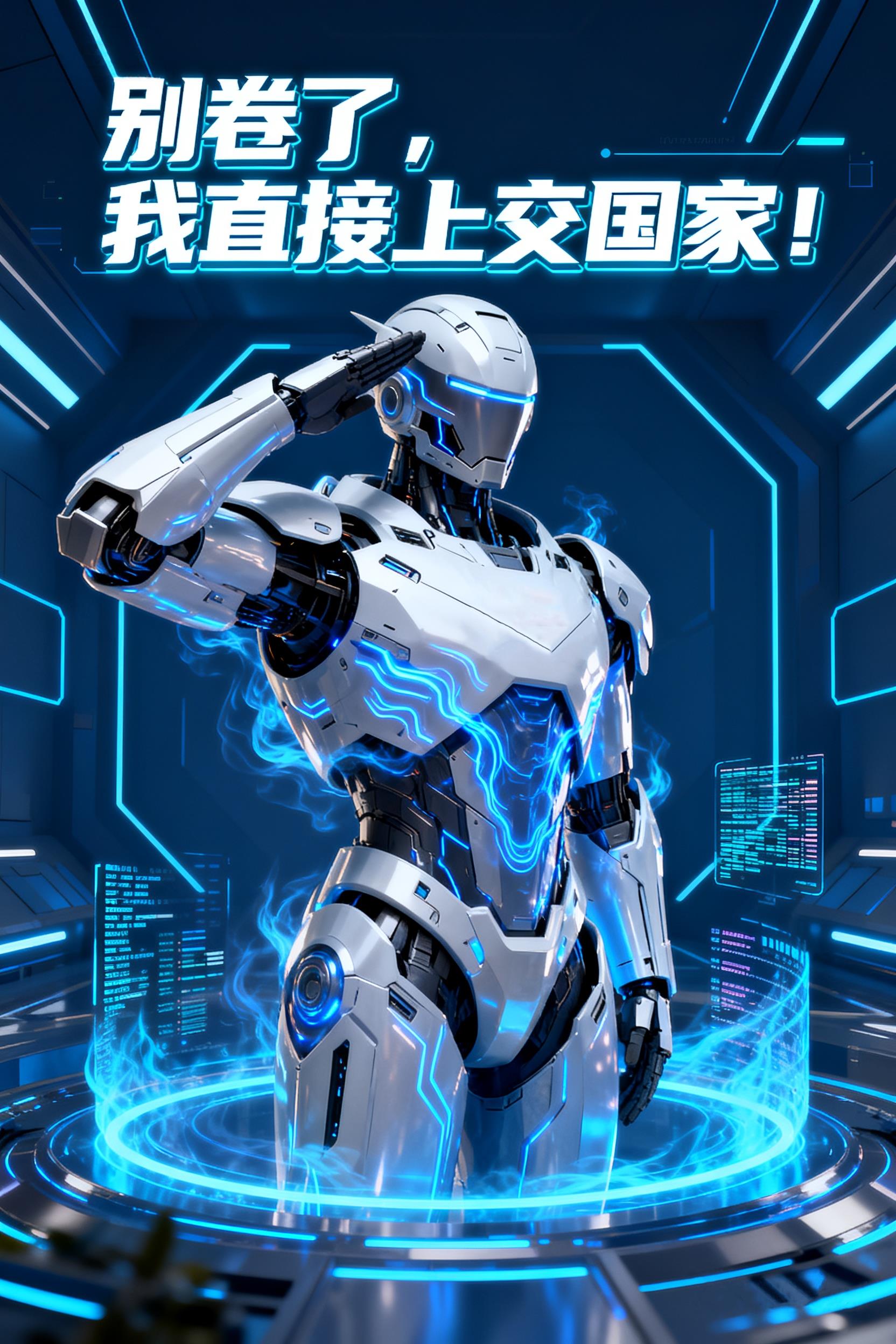
Chapter 185: Polar Expedition—100 Days of the
The 120th day after the document was released, on the ice sheet near Antarctica's Zhongshan Station.
Temperature: minus forty-two degrees.
Wind speed: force eight; the ice shards whipped up by the wind hit one's face no differently than a knife blade.
Lao Wu (Wu Jianguo), captain of the 39th Longguo Antarctic Scientific Expedition, stood before the observation window of the research station, holding a cup of coffee that had almost gone cold.
His eyes were fixed on the ten figures busy in the blizzard outside.
"Iron Wolf—Polar Special Modified Model," this was their official name.
But the team members had given each one a nickname: the leader was called Steel Egg, the transport one was called Mighty, and the drilling one was called Penetration King.
All were modified based on "Iron Wolf" technology, optimized specifically for the polar environment.
Three meters tall, one ton in weight, painted in an all-over snow camouflage, with anti-icing seals at the joints, and special snow-walking tracks for feet—similar to those on a tank—allowing them to travel steadily over soft snow.
Most importantly, the energy system: the "Xuanming-Polar" micro-fusion reactor, specially designed to output stably even in an environment of minus sixty degrees.
Laboratory data showed that low temperatures actually improved the performance of certain materials, with efficiency five percent higher than in room-temperature environments.
"Captain, Steel Egg and the others have been working continuously at the D7 drilling point for eighteen hours." Young team member Xiao Li leaned in, eyes fixed on the monitoring screen.
"Ice core sampling progress has reached ninety-three percent."
"What about the temperature?"
"The mechs' external sensors show it's now minus forty-five degrees, but it's still a constant twenty-five degrees inside the cockpit. Energy remaining... seventy-six percent."
Lao Wu nodded and took a sip of coffee.
This expedition team brought a total of ten polar mechs, with the mission: to drill for millennial ice cores, expand station facilities, and establish an Antarctic inland automatic observation network.
If done the traditional way, these tasks would take fifty people half a year to complete.
Now, it only required ten mechs and ten operators, with the plan to finish in three months.
"Today is the hundredth day, right?" Lao Wu asked.
"The hundred and third day." Xiao Li glanced at the calendar.
"Steel Egg and the others have been in Antarctica for a full hundred and three days. Still zero failures, zero downtime."
No sooner had he finished speaking than the alarm sounded.
"Emergency! The International Joint Research Station has sent a distress signal. Two Australian expedition members are missing in the C3 area. The blizzard is intensifying, visibility is less than ten meters, and their own snow vehicle has fallen into an ice crevasse."
Lao Wu's expression darkened: "Where is the location?"
"Just twenty-seven kilometers away from us. They are requesting assistance, saying if we have mechs, please help them."
The monitoring room was silent for two seconds.
Twenty-seven kilometers, blizzard, ice crevasse area.
Traditional snow vehicles couldn't get through at all, and for a helicopter to take off in this weather would be tantamount to suicide.
But the mechs could.
"Steel Egg, Mighty, Number Three Transport (mech nickname), prepare to depart." Lao Wu put down his coffee cup. "Xiao Li, you command remotely. I'm leading the team."
"Captain, you're going yourself?"
"Otherwise what?" Lao Wu had already started putting on his heavy cold-weather gear. "Those two lives can't wait."
Ten minutes later, three polar mechs drove out of Zhongshan Station.
Steel Egg (serial number Polar-01) took the lead, with Lao Wu in the cockpit.
The large screen displayed the external environment: a vast expanse of white, with wind-blown snow almost completely obscuring the cameras.
But the mechs' sensors were unaffected.
Thermal imaging, LiDAR, and acoustic detection—multiple data sources fused to construct a clear 3D terrain map on the AR interface.
Where there was solid ground, where there were ice crevasses, and where there was soft snow were all perfectly clear.
"Maintain formation, twenty-meter spacing," Lao Wu said over the communication channel.
"Do not exceed thirty kilometers per hour. The C3 area has dense ice crevasses; you must be careful."
"Received."
The three mechs advanced steadily through the blizzard.
The foot tracks pressed deep marks into the snow, but the mechs' self-weight was optimized for distribution, so they wouldn't collapse the ice layer.
Lao Wu looked at the energy reading: seventy-four percent. Enough for a sixty-kilometer round trip, with a margin to spare.
Twenty minutes later, they arrived at the edge of the C3 area.
"Life sign signal detected," the mech AI prompted. "Two o'clock direction, 1.2 kilometers away, two heat sources found, somewhat weak."
"Go."
The mechs adjusted direction, weaving through the dense ice crevasses.
Some crevasses were several meters wide and bottomless. Traditional vehicles would have to turn back here, but the mechs were different.
"Jump mode, activated."
Lao Wu pressed the button. The mech's leg hydraulic system pressurized, the tracks retracted, and suction claws popped out from the soles.
Run-up, jump!
The three-meter-tall mech traced an arc in the air and landed steadily on the other side of the crevasse.
The other two mechs followed closely behind.
1.2 kilometers—they took eight minutes because they had to constantly bypass or leap over crevasses.
Finally, beneath an ice cliff, they found the Australian snow vehicle stuck on the edge of a crevasse.
The vehicle body was tilted, with half a wheel already hanging in the air.
The two expedition members were huddled inside the vehicle, their faces deathly pale.
When they saw the mechs appear, both were stunned.
"My God... I'm not dreaming, am I!" the younger one muttered.
Lao Wu turned on the external speaker and said in English: "Longguo Antarctic Expedition, here to assist. Please stay calm, we will get you out immediately."
The mech walked to the side of the vehicle and scanned its status.
"Chassis stuck on the ice edge, right front wheel suspended. Recommendation: use a tow rope to secure the vehicle body, then lift."
"Execute."
Mighty (Polar-02) took a high-strength carbon fiber tow rope from the rear tool compartment, fixed one end to the solid ice surface, and tied the other to a sturdy part of the vehicle body.
Steel Egg walked to the front of the vehicle, deployed its mechanical arm, and supported the chassis.
"Ready... lift!"
The hydraulic system outputted at full power, and the two-ton snow vehicle was slowly lifted and moved back to solid ground.
The entire process took only three minutes.
When the two Australian team members crawled out of the vehicle, their legs were weak.
"Thank you... thank you so much..." The older team member shook Lao Wu's hand (the mech's mechanical hand). "In this weather, we thought..."
"Back to the station first," Lao Wu interrupted him. "Can your vehicle still drive?"
"Should... be able to."
"Then follow behind us. We'll lead the way."
On the return journey, the blizzard grew even stronger.
Visibility dropped to less than five meters, but the mechs' sensors still clearly guided the direction.
Lao Wu, in the cockpit, looked at the vast white world outside and suddenly remembered the scene from twenty years ago when he first came to Antarctica.
Back then, expedition members had to go out in pairs, carry all survival gear, and report their position to the base station every half hour; even so, many expedition members still encountered danger in Antarctica every year.
And now?
He glanced at the dashboard: external temperature minus forty-seven degrees, cockpit temperature twenty-five point five degrees. Energy remaining sixty-two percent.
Safe, comfortable, efficient.
This was the change that technology had tangibly brought.
By the time they returned to Zhongshan Station, it was two hours later.
The Australian team members were settled into the medical room; they only had mild frostbite and nothing serious.
Their leader, an old professor named Mike, even came specifically to thank Lao Wu.
"Captain Wu, your equipment... is truly impressive." Mike looked at the mechs parked outside the station. "Can I take a closer look?"
"Please."
Lao Wu led him to Steel Egg.
The snow-camouflaged mech stood motionless in the blizzard, the warning lights on its shoulders flashing slowly.
"What model of equipment is this? I've never seen it before."
"This is the Iron Wolf—Polar Special Modified Model, a polar operation mech independently developed by Longguo," Lao Wu paused. "Civilian version."
Mike opened his eyes wide: "Civilian? This performance... it already exceeds the military polar equipment of many countries."
"We focus more on practicality," Lao Wu smiled. "Would you like to try it?"
"Can I?"
"Of course."
Lao Wu helped Mike put on a lightweight spare operator suit; although it wasn't a full mech suit, it still had sensors and AR glasses, allowing remote access to Steel Egg's perspective.
When Mike saw the 3D world constructed by the mech's sensors through the AR glasses, his mouth hung open.
The vast white blizzard was filtered out on the screen, replaced by clear terrain structures, temperature distribution, ice thickness, and even underground water flow directions.
"This... this is practically cheating," Mike muttered.
"This is science," Lao Wu corrected.
That night, the Zhongshan Station canteen was exceptionally lively.
Longguo and Australian expedition members sat together eating, chatting about technology, Antarctica, and the future.
Mike asked Lao Wu: "How long will this batch of mechs stay in Antarctica?"
"The plan is six months," Lao Wu said.
"We'll withdraw after completing the drilling, expansion, and observation network construction. But the mechs themselves... their design life is ten years, and they can be deployed long-term."
"Ten years..." Mike was thoughtful.
"What if we cooperate? You provide the mechs, we provide scientific data and station support. Jointly conduct deeper Antarctic research."
Lao Wu thought for a moment: "I need to ask for instructions from home."
"Of course."
That night, Lao Wu contacted the Longyin Research Institute via satellite link.
Feng Yan, on the other end of the video, listened to the report and only asked one question: "What can they provide?"
"Long-term observation data from three inland Antarctic stations, raw data on ice sheet dynamics, and also..." Lao Wu pulled up a file.
"Their preliminary report on an unknown microorganism discovered under the Antarctic ice lake last year."
Feng Yan's eyes lit up.
Subglacial lake microorganisms were precious samples for studying extreme life forms on Earth, and even the possibility of extraterrestrial life.
"We can cooperate," Feng Yan decided.
"But with a few conditions: one, data sharing must be reciprocal; two, joint expeditions must operate using Longguo mechs as the platform; three, our side must have priority publication rights for all discoveries."
"Understood."
After communicating, Lao Wu returned to the canteen.
Mike was still waiting for him.
"How was it?"
"Home agreed," Lao Wu said, "but there are some conditions..."
He relayed Feng Yan's requirements.
Mike listened and smiled: "Very reasonable. In fact, if we had mechs, I think we would have proposed the same conditions."
The cooperation was thus settled.
The next day, after the blizzard stopped.
Sunlight spilled onto the ice sheet, reflecting a blinding white light.
All ten polar mechs were deployed, starting a new mission: drilling for subglacial lake samples near the coordinates provided by Mike.
This was the first time humans had attempted deep ice drilling using a mech platform.
Traditional drills required massive camp support and took months.
But the mechs were different; they carried their own energy, their own drilling equipment, and could move to any location.
Steel Egg and Penetration King (Polar-03) teamed up and started operations at the selected point.
The drill started, rotating at high speed, sinking into the ice layer.
Ten meters, fifty meters, one hundred meters...
At three hundred meters deep, the drill resistance suddenly decreased.
"Ice layer breached, entered water body," the system prompted.
Lao Wu held his breath.
The mechanical arm switched tools, took out a sterile sampler, and slowly lowered it.
Five minutes later, the sampler was retrieved.
In the transparent container was a small amount of dark red, viscous liquid.
"Sample acquisition successful."
The entire monitoring room erupted in cheers.
That night, the sample was sent back home via a special express plane.
Seventy-two hours later, the Longyin Research Institute biological laboratory sent back the preliminary analysis results:
"Three brand-new microorganisms were found in the sample, all possessing the ability to survive in extreme low-temperature, high-pressure, and lightless environments. The metabolic method of one of them... is unprecedented."
At the end of the report, the laboratory director added a note:
"The survival mechanisms of these organisms have important reference value for designing future extraterrestrial environment exploration equipment."
Feng Yan finished reading the report and pondered for a long time.
Then he dialed Li Yang's phone.
"Old Li, have you received the polar mech data?"
"Received. In low-temperature environments, material performance improved by five to eight percent, and energy efficiency also improved. But the lubrication system still has slight lag in extreme low temperatures and needs improvement."
"What is the direction for improvement?"
"Switch to a new type of low-temperature lubricant, or... redesign the joints to reduce friction surfaces," Li Yang paused. "Brother Feng, you're asking this, are you thinking about..."
"The Moon," Feng Yan said directly. "Antarctica is Earth's best simulation site for extraterrestrial environments. With slight modifications, polar mech technology is the foundation for lunar mechs."
The other end of the phone was silent for a few seconds.
"Give me three months," Li Yang said. "Based on the polar data, I can come up with a conceptual design for a lunar mech."
"Good."
Hanging up the phone, Feng Yan walked to the observation deck on the top floor of the research institute.
The night was deep, but the city was still brightly lit.
He looked south; 14,000 kilometers away in Antarctica, ten mechs were still working on the ice sheet.
Drilling, sampling, building, exploring.
And the data obtained from those explorations would soon turn into new blueprints, new designs, and new equipment.
Used for Antarctica, used for the deep sea, used for... the Moon.
At this moment, his phone suddenly vibrated; Feng Yan saw it was a message from Wang Hao.
"Brother Feng! I just saw a super awesome idea! Drawn by a high school student."
"Concept map of a self-assembling mech camp, mechs carrying modular components that automatically assemble into a research station upon reaching the destination! Although it can't be realized yet, the concept is absolutely brilliant!"
Feng Yan smiled and replied: "Get the blueprints and save them in the creative library. When quantum computing matures, maybe it can really be realized."
"Understood!"
Putting away his phone, Feng Yan took one last look at the night sky.
The starlight in Antarctica must be brighter than here, right?
He thought.
Because there was no light pollution there, only pure darkness and stars filling the sky.
And between those stars was the distant place humanity would eventually go.
Mechs would be the feet leading to those distant places.
The first step had already been taken on the Antarctic ice sheet.
Where should the second step lead?
He turned around and walked back to the brightly lit laboratory.
The answer was in those blueprints and data.
It was in the hands of this group of young people who were constantly striving.
Late night, Antarctica, Zhongshan Station.
Lao Wu hadn't slept yet; he was still organizing today's expedition log.
Outside the window, Steel Egg stood quietly beside the charging pile, the indicator light on its shoulder flashing rhythmically in the darkness of the polar night, like a star that would never go out.
Mike walked over and handed him a cup of hot cocoa.
"Wu, you Longguo people often talk about century-long plans. Is your investment in Antarctica for things a hundred years from now?"
Lao Wu took the cup and thought for a moment.
"Not entirely," he said. "We are doing it for tomorrow, the year after, ten years from now... and all the time that hasn't arrived yet."
He looked out the window, at that mech.
"Because some things, if you don't do them now, it will be too late forever."
Mike didn't quite understand, but he also looked out the window.
The snowstorm had returned.
Yet in the wind and snow, the outlines of those mechs remained clear.
Firm, stable, and unshakable.
End of Chapter