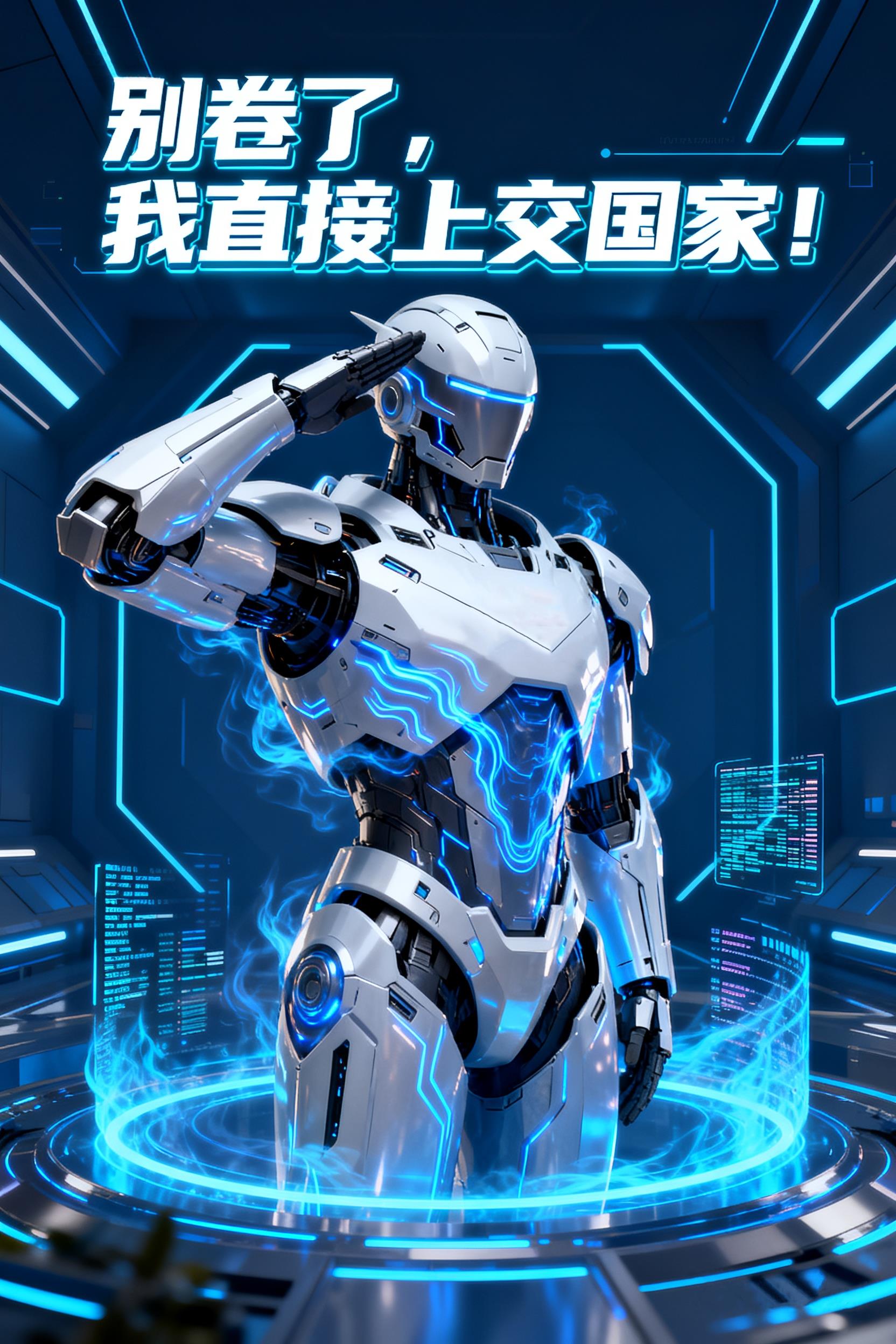
Chapter 283: Human Treasures Project
So we're supposed to stuff Beethoven and Li Bai into a missile and blast the aliens' brains?
During breakfast at the Dragon Chant cafeteria, Wang Hao bit into a bun, stared at the holographic projection of the plan draft, his expression somewhere between "This is too cool" and "This is too ridiculous."
Chen Guang slowly sipped his porridge: "To be precise, it's about taking all of humanity's cultural and artistic achievements—literature, music, painting, dance, drama, architecture, film, even folk tales and oral history."
They are digitized, encoded into special energy signals, and launched from the Heaven's Punishment Platform toward the direction where the Harvesters' fleet is expected to arrive.
Does this thing actually work?
According to γ-7 data, the Harvesters' logic core is built on "computability." Chen Guang pushed his glasses.
They can analyze our energy efficiency, technological level, and military capability.
But they cannot understand why humans would expend vast amounts of energy to paint a picture you can't eat, write a poem you can't build a house with, or film a movie you can't use as a weapon.
Li Yang interjected: "It's like asking an accountant to understand a poet—on the ledger, these are all loss-making ventures, so why bother?"
Yes. Chen Guang nodded.
So when we slam those "loss-making venture" data streams at them, their evaluation system could overload, glitch, or even crash.
Even if it stalls for just a few seconds, that's enough for our live-ammo weapons to score results.
Feng Yan sat down with his tray: "Project code name: Human Treasures. The global collection launches today at noon; anyone connected to the Profound Darkness Network can submit works."
From prehistoric cave paintings to the latest quantum art, not a single one can be missing.
"How much data would that be?" Wang Hao glared. "Eight billion people worldwide—if each person submitted just one photo, we'd still have..."
The estimated total data volume is around 10^22 bytes. Chen Guang said calmly.
It's equivalent to compressing all the information humanity has ever produced, then compressing it again. But Qiming optimized the encoding algorithm, allowing these data to be stuffed into a storage device the size of a soccer ball.
Of course, launching requires the Heaven's Punishment Platform to operate at full power, and it can fire only one shot at a time.
Is one shot enough?
Not enough, so we need to make a hundred. Feng Yan adjusted the production plan.
All high-end crystal wafer factories worldwide have switched to producing the core storage units for civilization signal shells. The first month's target output is thirty units, then fifty per month thereafter until we reach a hundred.
Zhao Kaiyuan's hologram popped up: "I've got the energy covered. The vacuum zero-point energy experimental reactor succeeded in a trial run yesterday—although its power is still under 10% of design, it's enough for a few signal shells."
What is it?
It's just that this thing consumes energy terrifyingly. Zhao Kaiyuan gave a bitter smile.
Firing one signal shell consumes enough electricity to power Cherry Blossom Province for a month. Without the γ-7 algorithm backing us, we couldn't afford such a lavish artistic attack.
Even if it's extravagant, we have to play it. Feng Yan said, "War isn't just about firepower; it's also about imagination. All right, let's get to work."
At exactly noon, the global collection launched.
All terminals of the Profound Darkness Network—phones, computers, public screens, even street-side exoskeleton displays—simultaneously popped up the same interface:
【Human Treasures Project: Please leave behind what you find most beautiful and incalculable in your heart】
Below are three options: upload work, create online, oral record.
At the Cloud River City central cafeteria, Lao Wu had just finished lunch when he saw the prompt on the cafeteria's big screen and froze for a moment.
The young person next to him had already pulled out his phone, found the photo of his daughter's first drawing in the album, and uploaded it.
"Uncle Wu, aren't you going to upload something?" the young person asked.
Lao Wu scratched his head: "I'm just a skewer vendor—what art do I have?"
"Who says skewers aren't art?" the young person laughed.
"Your heat control and seasoning ratios are more precise than a lab experiment. Let me say, this is culinary art!"
Those words made Lao Wu's eyes light up.
He pulled out his phone—a military-issued model distributed during wartime, drop-resistant, waterproof, and even usable as a brick—opened the video function, and pointed it at the kitchen for a five-minute clip:
The mechanical arm flips the skewers, seasoning precisely sprinkles, oil droplets sizzle when they hit the charcoal fire, and there's the crisp "crack" sound when plating at the end.
Video title: "A Barbecue Stall Owner's Perseverance"
Upload successful.
Almost simultaneously, similar things were happening all over the world.
In Kyoto, a ninety-year-old calligrapher, trembling hand, wrote the four large characters "Everlasting Life," the camera recording each stroke's beginning, development, turn, and conclusion.
In Paris, a street performer played violin at the subway station, the sound transmitted via pickup to the entire network.
In Rio de Janeiro, a child from the favelas graffitied on a wall, depicting the Heaven's Punishment Platform in the night sky.
In Cairo, an archaeologist uploaded the holographic scan data of the pyramid's interior—those geometric patterns from four thousand years ago.
In Tokyo, the animation studio made public the original drafts of all its unreleased works.
In Mumbai, Bollywood directors jointly edited a three-minute microfilm, distilling the essence of a thousand years of Indian dance.
What used to be Eagle Country is now Washington D. C.; Broadway actors performed the Hamlet soliloquy in an empty theater, the camera sweeping over the neat rows of empty seats below.
A flood of data surged into Qiming's algorithm servers.
Chen Guang watched the exponentially rising upload curve in the monitoring center, pushing up his glasses:
At this speed, we can finish gathering the basic material in three days. But the encoding work… will require at least a hundred thousand artists to help.
Where are the artists now? Feng Yan asked.
Most are at various cultural protection centers; under wartime measures they're classified as non-essential personnel, but they also need to participate in production labor. Chen Guang marked out the distribution map.
We can concentrate them at the Moon Base to work alongside Qiming—it's safe, and we can make use of Qiming's computing power.
Then let's mobilize them. Using Penglai Transport, they'll all be in place within three days.
Moon Base, the newly built Civilization Encoding Center.
When the first batch of three thousand artists arrived, they gazed at the spherical hall five hundred meters in diameter and the levitating Qiming Core at its center, and fell silent together for ten seconds.
"This… is where we're supposed to work?" an elderly painter with white hair asked.
Yes. Chen Guang stood at the entrance, pointing to the workstations encircling the hall.
Each workstation is equipped with a neural interface that can directly connect to Qiming.
Your work is not creation, but feeling, to re-experience humanity's art history in the algorithmic space, letting Qiming record your emotional fluctuations, flashes of inspiration, those moments that cannot be quantified.
A young composer raised his hand: "What about our works?"
"They've all been entered into the database." Chen Guang pulled up the interface.
End of Chapter