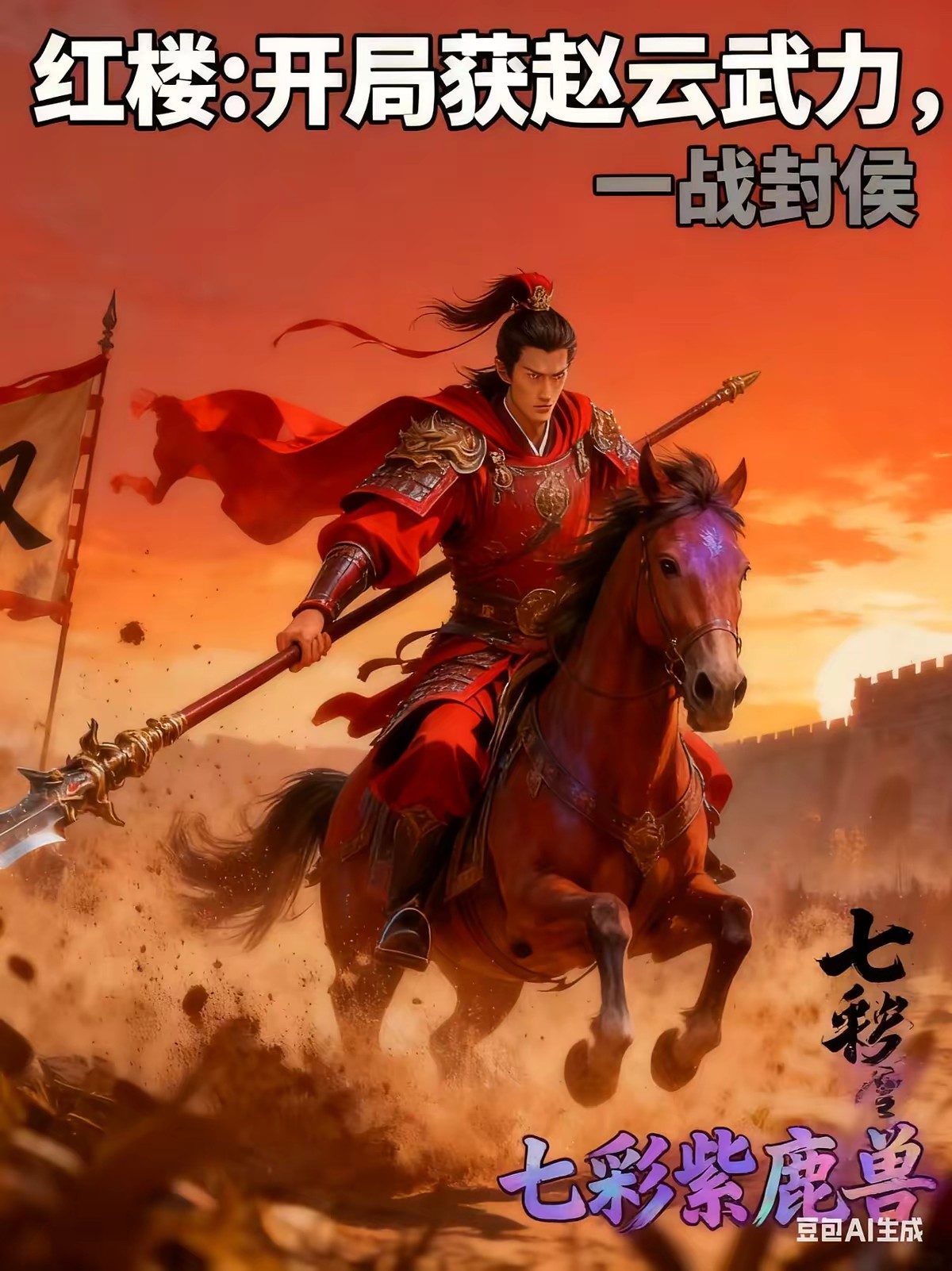
Chapter 283: Kai Le Welcomes, Performing All Four Movements of Po Zhen!
West of Lugou Bridge,
After Jia Jing appeared, the atmosphere on the spot instantly became lively; countless people shouted cheers for him, and countless others praised his divine and heroic bearing.
Following Jia Jing, Zhou Yingyuan, Ma Guocheng, You Shiyong and other Han Army officers slowly emerged, each in full armor, their expressions solemn.
After the officers came the ten formations of iron cavalry leading the way, brandishing banners.
The ten cavalry formations at the front were handpicked by Jia Jing from the Bashang Daying and the northwestern border troops, undeniably the elite of the elite.
They were either warriors who had slain countless enemies in this northwestern great battle, or sharp men who had earned one of the four great military merits: cutting generals, seizing flags, or being the first to breach the formation.
Jia Jing had personally met each of them before, and bestowed upon them the honor of appearing at the front in this triumphant return to the capital.
Behind the ten iron cavalry formations came a massive block of cavalry.
The Xuanjia Elite Cavalry led the way, clad in black armor, riding black horses, wearing black helmets and black tassels.
Two thousand four hundred Xuanjia Elite Cavalry were arranged into five blocks, each block with over four hundred riders.
All the horses were uniformly black, the armor uniformly dark, and even the riders' expressions were the same—stern and silent—exuding an astonishingly fierce aura.
These are the Xuanjia Elite Cavalry forged by Jia Jing as a reward in the northwestern system, built from the Xuanjia troops as the core, spending vast manpower and resources, and forged through many great battles into an elite heavy cavalry unit.
Behind the Xuanjia cavalry came a formation of over twenty thousand cavalry, including riders from Bashang Daying and selected sharp troops from the northwestern border army.
The over twenty thousand cavalry were arranged by banner units, their iron armor clanged, their ranks immaculate, heads held high, and the raised swords and spears gleamed brilliantly!
The troops slowed their advance a few li away from the imperial tent.
At that moment, a drum sounded beneath the Yellow Tent, followed by a deep, grand melody slowly playing from the side of the Yellow Tent.
These were the ceremonial music of drums and fanfares used by the Ministry of Rites and the Honglu Temple to welcome the triumphant soldiers.
Jia Jing's face as dark as black water tightened his reins, leaned his ear to listen for a moment, and his brows slightly furrowed.
At his side, Zhou Yingyuan urged his horse forward a few steps, moved behind Jia Jing, and asked in doubt:
"General! This music appears to be imperial music, the 'Kai Le' that was performed just before the Noon Gate."
"Huangzhong Dalu, drums invigorate, playing all four movements of 'Po Zhen Music', not the usual triumphant drums!"
Zhou Yingyuan's return to the capital this time was to pay audience with the emperor; although he had been recommended by Jia Jing as the commander of the northwestern border.
But he still needed to report to the Ministry of War and the Five Military Governor's Office, and also have an audience with Emperor Jing Sheng Di!
And his claim that the music was wrong does have basis!
The Da Han Empire's triumphant ceremony music has the characteristic of a fixed form but content varying with circumstances.
The repertoire and main melody are basically fixed, with grand structure and mighty momentum.
Royal music used at celebrations includes 'Wan Sui Music', 'Zhao Tianzi', 'Shui Long Yin', and so on.
The dances most directly related to military triumphs, such as the 'Ping Ding Tianxia Dance', are accompanied by music like 'Si Bian Jing' and 'Feng Luan Yin'.
When generals return victorious, the usual pieces are 'General's Victory Decree', 'Warrior's Joy', and the like.
However, above ordinary ceremonial music there exists the 'Emperor's Exclusive' repertoire,
In the Da Han Empire, when the emperor leads a triumphant campaign, there is a top‑grade exclusive triumph music called 'Kai Le', also known as 'Drum Fanfares Music'.
Its appearance itself is historic.
During the Chengzu era, Han Chengzu repeatedly campaigned against Liaodong and the northwest, returning in triumph.
The court wished to hold a triumph ceremony according to protocol, but the Ministry of Rites could find no precedent in the archives.
Finally, the Ministry of Rites combined earlier pieces to create 'Kai Le' as a special tribute for the emperor's triumph,
Carrying the imperial authority of 'the Son of Heaven on the throne, all lands come to pay homage'.
Since its creation, 'Kai Le' became the emperor's exclusive ceremonial music throughout the Da Han Dynasty.
Since Chengzu, it had never been performed again, and no one expected it to sound today beside Lugou Bridge.
Jia Jing, hearing Zhou Yingyuan's question, set his face solemn and said in a deep voice:
"General Zhou, go ask, what exactly is going on?"
"How can a minister use the emperor's exclusive music? This is overstepping; I dare not accept it!"
Jia Jing's expression tightened slightly, suspecting that these Ministry of Rites officials might be trying to trap him as they did with Geng Yao and Yin Zhen years ago.
However, with Emperor Jing Sheng Di present, they should not make such obvious moves!
Zhou Yingyuan bowed his hands in compliance, immediately spurred his horse and galloped toward the imperial tent.
In front of the imperial tent,
Zhou Yingyuan dismounted from a distance, hurried forward, knelt on one knee, and addressed Emperor Jing Sheng Di:
"Your Majesty! Lord Jing has sent me to inquire; this music appears to be imperial music, Lord Jing dares not accept it, please give your command!"
A moment of silence fell before the imperial tent, and countless civil and military officials looked at each other in surprise,
It seemed they did not expect Jia Jing, at the height of his military achievements, to be so cautious.
Now, using this as a lever to impeach his arrogance would have no footing!
The youngster is truly hard to deal with!
Emperor Jing Sheng Di, upon hearing this, was momentarily stunned, then looked toward the figure in the red robe in the distance and said with feeling:
"Why would he dare not accept it! Zi Jie extinguished the Northern Yuan in the northwest, pacified the grasslands, defeated the chaotic evil, his merits shine through the ages, and he has great favor to the state and to me."
"Only imperial music can match his merits! Go back and tell Zi Jie not to worry!"
Having finished, to allay Jia Jing's concerns, he sternly said to the nearby Xia Shouzhong:
"Da Ban! Convey the decree: Lord Jing Jia Jing, meritorious to the state, is specially ordered to be granted imperial music to welcome the triumph, by imperial command!"
As soon as Emperor Jing Sheng Di's words fell, Zhou Yingyuan immediately bowed his head, remounted, and rode back.
Jia Jing, after hearing Zhou Yingyuan's slightly emotional report, fell silent for a moment, and his face inevitably showed a hint of sentiment!
Emperor Jing Sheng Di's regard for him was truly deep and loyal, a vast heavenly grace!
As the drum music continued to sound, the iron cavalry also slowly moved forward.
Accompanied by the sound of drums and music, a burst of celebratory song from the musicians also rose:
"Wolf Mountain snow, reflecting iron armor, night the ten‑thousand riders charge the royal court."
"Golden tent collapses, great banner shifts, a live capture of the Khan presented at the vermilion steps."
"Nine battles, nine victories sweep the northern desert; across the thousand‑mile grassland, red banners fill the sky."
"The Tatars, chilled with fear, dare not graze; from now on Yin Mountain has no Hu cavalry."
……
"West of Tianshan, the setting sun low, the barbarian hordes, sixty thousand strong, form a solid rampart."
"The divine bow under the full moon releases two arrows; blood stains the yellow sand, shattering the commander's banner."
"The King of the Western Regions, the Manchu envoy, vie to present surrender maps and worship the banner."
"The holy sovereign arrives, opening a jade banquet; the general brings his sword into the golden boudoir."
The "Kai Le" melody has a fixed tune, but its lyrics are filled in by civil officials of the Ministry of Rites based on the specific battle deeds and victory characteristics,
to achieve the purpose of extolling the saintly virtue and urging the troops while mocking the enemy.
Therefore, the lyrics of this soaring "Kai Le" are uniquely created from Jia Jing's battle record.
As a result,
Jia Jing's achievements this time almost become a part of the Da Han Empire's "musical movement", its aesthetic influence and historical status will remain in the annals, co‑constituting the most solemn official court narrative.
End of Chapter