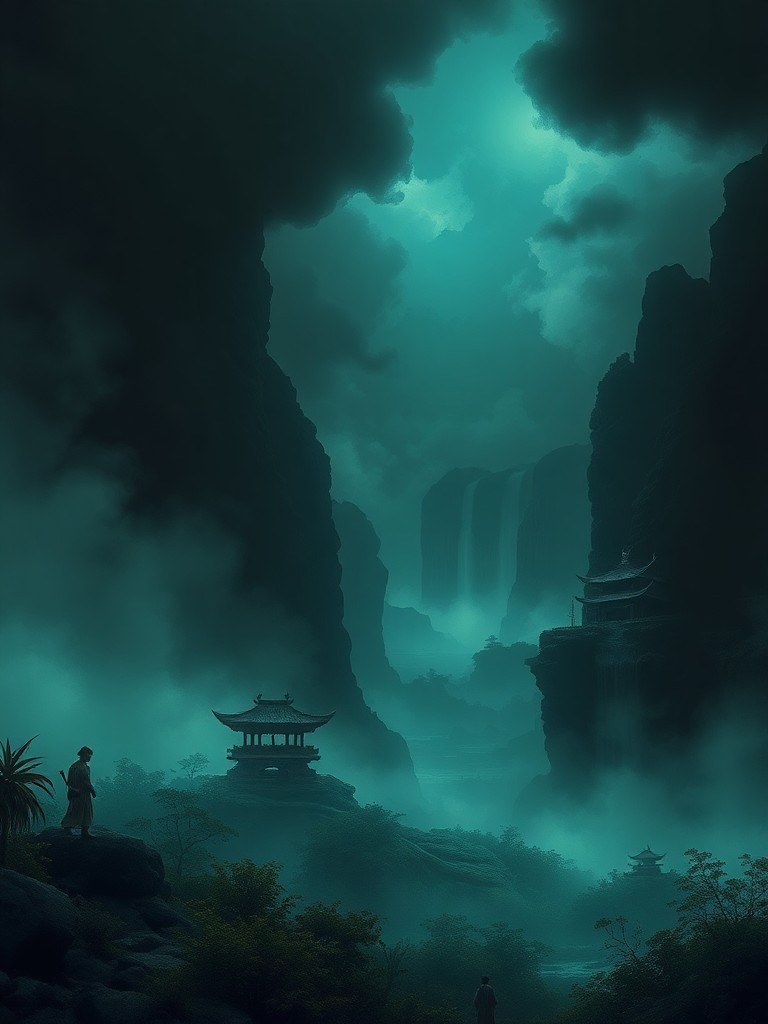
Chapter 81: God of Wealth
"The corpse is gone?" Seeing Seeing Ning Zhe tilted his head slightly and looked at Shi Yurou's left hand.
Her left wrist was tied with two loops of red string, with four copper coins threaded onto them.
"According to what you said, after the corpse disappeared, the copper coins you and your brother carried with you each lost one. Are you talking about the ones on your wrist?"
"Yes." Shi Yurou walked closer and extended her fair wrist toward Seeing Seeing Ning Zhe so he could see the appearance of the copper coins tied to the red string clearly.
Normal copper coins are generally round on the outside and square on the inside, embodying the concept of "heaven is round and earth is square," and also implying that nothing can be accomplished without rules. However, the four copper coins tied to Shi Yurou's wrist were the exact opposite; all four were square on the outside and round on the inside, displaying a brass metallic color under the light.
"Would it be convenient to untie the string and let me take a look?" Seeing Seeing Ning Zhe asked.
Shi Yurou shook her head gently: "I'm sorry, my father specifically instructed before he died that this string of copper coins must be carried with us at all times and must never be given to anyone else, not even my mother."
"I see..." Seeing Seeing Ning Zhe waved his hand, signaling her to raise her wrist slightly so he could get an angle to observe the inscriptions on these four inverted, square-outside-round-inside copper coins.
There were characters on both sides of the copper coins; one side read 【Peace and Joy】, and the other read 【Everything Goes as You Wish】. It was impossible to tell which side was the front.
"My brother and I have carried this string of copper coins with us since we could remember. There were originally five, but one went missing after the wake last night," Shi Yurou continued, showing Seeing Seeing Ning Zhe the empty knot on the red string.
The missing corpse and the missing copper coin—was there any connection between them?
"Did your father say anything else?" Seeing Seeing Ning Zhe shifted his gaze away from her wrist and asked.
"No." Shi Yurou shook her head and said: "My father said that after he died, I just needed to invite the people on the list, bring them to the study, and inform them of his will, and they would know what to do."
Seeing Seeing Ning Zhe scratched his head.
If Yu Zi Qian himself or other Ascenders on the list were here, perhaps they would have already understood something. But the memory content Seeing Seeing Ning Zhe had of Yu Zi Qian was very limited. After hearing Ji Bochang's will, he couldn't say he had a sudden realization; at the very least, he was completely in the dark.
He didn't even know who Ji Bochang was.
Let's start by sorting through the currently known information...
First, after Ji Bochang died, his corpse underwent an anomaly and disappeared in the middle of the night.
Given that previously at the Bishushanzhuang, Te Rang had also possessed and manipulated the corpses of the deceased within the manor, and knowing that Ji Bochang knew multiple Ascenders and was highly likely an Ascender himself, Seeing Seeing Ning Zhe could reasonably assume that the ghost Ji Bochang controlled had occupied his corpse after his death, macroscopically unfolding into a Strange World event.
But the danger level of this Strange World event didn't seem as extreme as Te Rang's. When Ji Bochang's corpse underwent the mutation, both Shi Yurou and her brother Ji Yunying were present, yet both survived.
"Or perhaps their survival is related to that string of copper coins they carry with them..." Seeing Seeing Ning Zhe added in his mind.
Ji Bochang made a will before he died, asking his children to invite Ascenders according to the list to attend his funeral. It was highly probable that he knew the rules would spiral out of control after his death, so he invited other Ascenders to help resolve the Strange World event triggered by his death.
The relationship between Ascenders is very loose; there is no unified organization or institution to manage them. The Ascension Network is just a dark-web forum where Ascenders gather to chat occasionally, not an organization name.
Therefore, the Ascension Network wouldn't be like an adventure anime in another world, where a request is posted on a board saying "xx Strange World event has broken out in xx place, cordially inviting Ascenders to resolve it, reward xxxx..." Such things do not exist on the Ascension Network.
Every Ascender is a footloose lone wolf. If converted to a Xianxia world, it would be a lawless land with no sects, only rogue cultivators.
"Is that so? 'Bring the people to the study, inform them of the will, and they will know what to do'... is that it?"
Seeing Seeing Ning Zhe whispered to himself, looking around, and began to observe the environment of this study.
As Shi Yurou said, this study remained in the same state as before Ji Bochang's death, without the slightest change. The brush, ink, paper, and inkstone were all displayed on the table, and half a piece of unfinished calligraphy was pressed under a paperweight, with the content:
【Better to eat without meat, than to live without】
There was no next line.
Seeing Seeing Ning Zhe looked at it twice more and felt that the calligraphy was just so-so; the soft brushwork was like someone with a kidney deficiency. It wasn't even as vigorous and powerful as the old man who helped people write Spring Festival couplets for 15 yuan in Gubeizhen. Was this the great calligrapher of Yunzhou?
Maybe this is art; mortals don't understand. He continued to look around. On the shelves against the wall, there were various porcelains and cultural artifacts: clean vases, tea pets, teapots, dragon blood tree bonsai, and several "nothing-to-do" plaques hanging on the shelves. The surrounding walls were covered with Ji Bochang's own calligraphy and paintings.
On a log tea table not far from the desk, a full set of Ru ware tea sets was laid out. On a small charcoal stove with gentle heat sat a round, ceramic water kettle. Shi Yurou, with her sleeves rolled up, sat on a rattan chair next to the tea table, using a bamboo tea needle to break apart a tea cake.
Her movements weren't very skillful; it looked like she didn't often make tea for people.
Seeing Seeing Ning Zhe walked closer and glanced at the vigorous and steady stove fire under the kettle, saying softly: "Jujube pit charcoal? That's quite particular... but aren't you moving your father's things by brewing tea here?"
He remembered that Ji Bochang's will was for Shi Yurou and her brother to keep everything he used in its original state.
"When a guest comes, tea must be served for hospitality; etiquette cannot be lacking." Shi Yurou's voice was very pleasant, soft and soothing: "Besides, my father usually used another set of purple clay tea sets. This set belongs to my mother; I'll just put it away after entertaining the guest."
"I see." Seeing Seeing Ning Zhe's gaze shifted away from the small charcoal stove, swept over the full set of tea sets on the table, and finally rested on the teapot covered in cracks: "Although knowing etiquette is a good thing, a 'Seven-Firing Pot' is generally not really used to brew tea; this thing is a cultural artifact."
"Eh?" Shi Yurou opened her eyes wide, only then realizing she had grabbed the wrong teapot in her haste.
She hurriedly put away the pot covered in cracks on the table, replaced it with an ordinary porcelain pot, and said humbly: "I'm really sorry, you've seen a joke..."
Seeing Seeing Ning Zhe shook his head, said nothing more, bent down, and picked up a toad placed on the tea tray.
This was a tea pet carved from yellow stone, a gold-swallowing toad the size of a fist, with a copper coin in its mouth. Like the copper coins on Shi Yurou's wrist, it was square on the outside and round on the inside. The bumps on its back felt warm and smooth; it had been nurtured for many years.
=9+Shu_ba
Seeing Seeing Ning Zhe put the gold-swallowing toad back in its original place and continued to observe the environment in the study.
Besides the pot that Shi Yurou had just put away, there were several other teapots on the shelf for cultural artifacts, with small mouths and big bellies, covered in cracks.
"It can be seen that Ji Bochang liked to pretend to be elegant before he died, it's just a pity he only learned some dregs." Seeing Seeing Ning Zhe sighed softly, having gained some understanding of Ji Bochang's character.
These teapots covered in cracks are a special kind of cultural artifact, originating from ancient pot-mending craftsmen.
At that time, porcelain was relatively precious, and people couldn't bear to throw it away if it accidentally cracked, so they would send it to a porcelain master to repair and continue using. The master would re-splice the cracked porcelain and use staples to bite the cracks, so it could be used again.
Pot-mending was originally just a craft to make a living, but ancient dignitaries, not knowing if they were full and bored, felt that repaired teapots had a unique beauty of imperfection compared to complete ones, and actually started deliberately smashing precious teapots to repair and display them for appreciation.
This process of pot-mending is called 'Ju'.
Later, Ju-pots even developed industry standards and a standard industrial chain. Because the direction and trend of the cracks from manually smashing a pot were uncontrollable and affected aesthetics, a standard process emerged: filling the teapot with dried soybeans, pouring in water, tying it up, and waiting for the soybeans to swell overnight to crack the pot. Teapots cracked by soybeans cracked evenly and beautifully, and had higher ornamental value after being repaired.
On this basis, some people would put a teapot that had already been cracked and repaired once back into soybeans to crack it again, and then repair it again.
Cracked and repaired, repaired and cracked, repeated seven times, this is the cultural artifact called 'Seven-Firing Pot' displayed on this shelf.
Seeing Seeing Ning Zhe's evaluation was that these people were still too full.
Counting them, there were exactly five Seven-Firing Pots on the shelf, and in the center position of these five pots, a small statue was placed, faintly forming a trend of stars surrounding the moon.
The statue was carved from yellow stone, a child sitting cross-legged, looking about five or six years old, with a full forehead, round cheeks, thick and fleshy earlobes, an auspicious appearance, and dressed in wealthy attire.
"This is the idol my father liked most before he died." Shi Yurou stood up from in front of the tea table, came to Seeing Seeing Ning Zhe's side, and introduced it.
"Idol?" Seeing Seeing Ning Zhe hissed softly: "What god is this child?"
This cross-legged child statue didn't have anything like a lotus pedestal under its butt, so it was clearly not a Buddha statue or a Buddhist boy statue. In Seeing Seeing Ning Zhe's impression, few gods in other religions fit this image.
Shi Yurou thought for a moment and replied: "I heard my father say before, this is—the God of Wealth."
(End of chapter) ===== CHAPTER 82 =====
End of Chapter