Chapter 265: The Prophecy of the End
When the runes began to rotate, Wu Chang understood everything.
The scrambled footage on the screen was not caused by the recorder accidentally pressing the record button, nor was it deliberately engineered to achieve this effect.
The scrambling of the footage was because the images within were not recorded video, but the actual scenes seen by Colonel Johnson and his three companions—the very scenes all four witnessed simultaneously!
With every frame, the perspective switched, incessantly shifting viewpoints; each protagonist's differing understanding and perception of their surroundings inflicted spiritual contamination upon the viewer.
The runes provided by the Omniscient Crystal, through a unique rotation, separated the four perspectives, ordered them correctly, and unveiled the truth before Wu Chang.
Colonel Johnson and his three companions were all trapped in a nightmare.
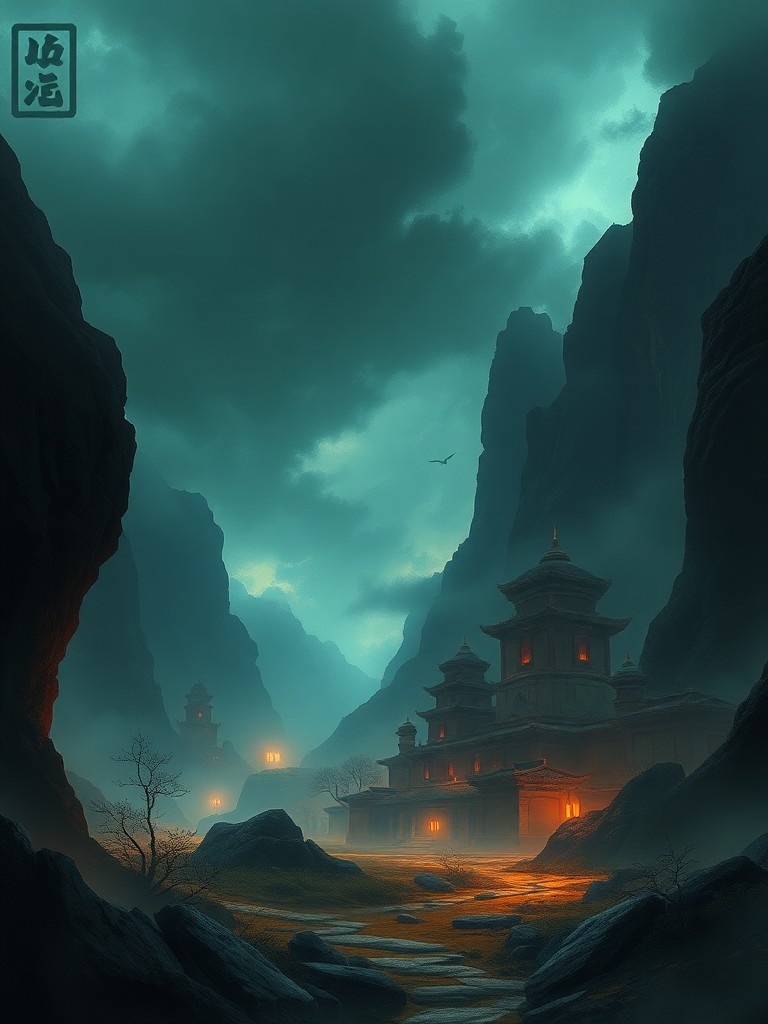
They found themselves inside a vast ruin, fleeing in panic as if escaping something.
It was like a game of tag with ghosts—when a person was caught by a ghost, the game ended.
Colonel Johnson and his three companions played the role of the humans, while the thirty-eight fish-headed beings played the ghosts.
The four of them split up, avoiding the fish-headed beings while searching for an exit from the ruin.
The fish-headed beings moved slowly; as long as they did not enter within three meters of them, they would not initiate an attack.
It seemed easy to evade them, yet no matter how they fled, no matter which direction they initially took, they would always converge at the same location after ten minutes.
That location was the square stone platform shown at the end of the video.
The white conch shell placed upon the platform seemed to announce their failure in this round of the game.
In the video, all four men fixed their gaze on the white conch shell, allowing the final few seconds of footage to stabilize; when Wu Chang truly understood their perspectives, in the final moments of the screen, he saw not only the white conch shell, but also the thirty-eight fish-headed beings standing behind it.
The fish-headed beings held hands and chanted in unison with strange voices.
The sounds they emitted were neither human speech nor roars, but the crash and surge of ocean winds, as if they pressed the white conch shell to their ears and listened to the tide within.
Under the crashing waves, the four men showed expressions of agony; they wanted to beg, but could not open their mouths; they wanted to flee, but could not even control their gaze.
They were not even allowed to surrender.
They would only hear, as their minds neared collapse, a faint voice within the waves: "You are the chosen ones."
Then they would be returned to the starting point, beginning the next round of ghost-tag.
Again and again, without end.
The vast majority of Johnson and the others' consciousnesses were bound within the television, with only a tiny fraction—nearly instinctual—remaining outside.
To extract information from the four, they must first be awakened from the nightmare.
Wu Chang informed Xiang Jianxing and the others of his discovery, asking if they had any way to awaken the four.
Xiang Jianxing and the others exchanged glances, all showing expressions of embarrassment.
Even the four major organizations had no surplus resources; let alone Director Gao and Lei Huo, even Xiang Jianxing, whom the Administration held in high regard, had every resource allocated precisely, with no capacity to purchase rarely-used auxiliary skills.
As for auxiliary equipment, there was none at all.
As one of the four major organizations, the Administration itself was a vast platform; any surplus equipment obtained from dungeons was immediately listed on internal trading channels, appraised by officially certified evaluators, and put up for sale.
Only Wu Chang, who might possibly need them, carried large quantities of high-level equipment on his person; other players, upon acquiring high-level gear with low compatibility, would sell it off immediately.
One reason was resource scarcity—players had to fully utilize every ounce of output.
Another reason was the overall scoring system during dungeon matching; in most cases, the difficulty of the dungeon matched by the Abyss Game would not deviate much from the player's current overall score.
A player's overall score included fixed attributes on their stat panel, as well as the levels of learned techniques and possessed equipment.
A high-level item, even if rarely used, would significantly raise the matching score, making it more likely to be assigned to a difficult dungeon.
Wu Chang, however, had no concern over this—he enjoyed administrator privileges; even if he entered a dungeon naked with no gear, the administrator would directly assign him the highest difficulty.
Seeing the group remain silent after each question, Wu Chang sighed, deciding he would have to handle it himself.
The World Dungeon was approaching; it was time to make some noise.
He took out the "Loud Horn" and said to the group: "Forcing them awake may have side effects—if anyone becomes emotionally unstable after awakening, restrain them immediately."
Seeing the group ready, he blew the horn with full force; as the horn's sound echoed, the television screen in the lounge flickered violently, then abruptly shut off.
"Equipment Skill: Inspiring Sound"
"Skill Description: Blow the horn to free the selected target from spiritual control, forcibly awaken them, and place them in an invigorated state; the awakening effect depends on the user's inspiration."
"Note: If the target's spiritual control level is B-class or higher, there is a probability they will fall into a chaotic state after forced awakening, attacking indiscriminately regardless of ally or enemy—use with caution."
The Trembling Ice Plain dungeon, a B-class dungeon nearing collapse, meant Johnson and the others were under extremely high-level spiritual control; forcibly awakening them would cause the Scholar and the Nalu Shaman to descend directly into madness.
Fortunately, neither was a combatant, and subduing them required little effort.
Colonel Johnson and the station manager Pei Taiheng, perhaps due to their relatively safe occupations and lower inspiration values, regained clear consciousness upon awakening.
After awakening, they showed no signs of aggression, merely groaning while clutching their heads; after two or three minutes, they gradually recovered, looking at Wu Chang and the others and asking:
"Who are you? New members of the survey team?"
Wu Chang gave Lei Huo a glance; Lei Huo, who knew the dungeon situation best, stepped forward and explained to them what had occurred at the Night Island Survey Station.
Lei Huo's account was detailed; his upbringing had instilled in him a polished official tone, unmistakably revealing his government background.
This allowed the two men, after brief exchanges, to place their trust in Lei Huo.
For Johnson and Pei Taiheng, it was as if they had awoken from a long dream; to them, both the nightmare within their minds and the reality of their physical bodies felt like dreams, and they could only recall fragments.
As Lei Huo recounted the details, their hazy memories gradually sharpened and aligned with the facts he mentioned, further convincing them of the group's identity and lowering their guard.
Seeing the two gradually return to themselves, Wu Chang asked:
"Colonel Johnson, do you remember what happened at the survey station originally?"
At the mention of the day of the incident, Johnson involuntarily shuddered; Pei Taiheng's gaze darted away—they both refused to recall that past.
As a veteran, Johnson's will was somewhat stronger; after composing himself, he recounted what had occurred at the Night Island Survey Station.
Although Johnson was among the last to arrive on the island, his military rank was the highest in the station, and he was the military's designated officer in charge.
The team he led was precisely the one Wu Chang had seen in the resentment.
When he led his team onto the island, the station had already largely deciphered the rules of Night Island, and the investigation of the underwater ruin had entered its final phase.
Precisely because of this, he had permitted Wiles, who was stationed at the rear and lacked mobility, to join the team.
Put nicely, this is the final sprint phase of underwater ruins archaeology.
Put crudely, it's just a gold-plating mission to pick the ripe fruit.
But no gold was plated, and they nearly lost their lives inside.
The gold-plating team led by Johnson lost two members on the way before even reaching the observation station; after entering, strange incidents occurred constantly.
Mysterious black shadows began to flicker outside the observation station, and team members were occasionally snatched into darkness by them.
Hiding inside the station wasn't necessarily safe either—residents began experiencing hallucinations, constantly seeing inexplicable characters before their eyes, and started having nightmares at night.
In their dreams, they became fish-headed human monsters, wandering through the ruins, waiting for something in the deep sea to awaken.
They could hear indistinct whispers in their dreams, but forgot them completely upon waking. Though they couldn't clearly see the characters in their hallucinations or hear the murmurs in their dreams, both greatly enhanced the team's inspiration, greatly accelerating their deciphering of the ruins' lost texts and murals.
With the help of the local Naru people, they quickly learned the ruins' background.
The underwater ruins were a temple built by the ancestors of the Naru people, and what was enshrined there was not a god, but a concept named Death.
The Naru ancestors held a fanatical worship of death, believing that after death, the soul would achieve eternal peace, merging with the world and becoming part of it.
Every deceased member of the tribe would come to Night Island just before dying; they believed that in the state of imminent death, the soul would fuse with the will of the world, and through this brief fusion, they could borrow the world's perspective to glimpse the future and leave prophecies for their clan.
But after performing one such prophecy, the Naru Death Temple was submerged by seawater.
Progress in interpretation energized the team—they no longer rejected hallucinations and nightmares; some even began actively seeking those sensations, trying to understand and listen to them.
In the second week of the sprint phase, some began losing the distinction between reality and nightmares; the first to change were the team's theologians and archaeologists.
They seemed to have truly become fish-headed humans, eating only raw, unprocessed fish and shellfish, rejecting vegetables and meat.
Even while awake during the day, they entered sleepwalking states, attempting to harm other members or themselves—but whenever they were asked to interpret information about the ruins, they returned to normal and displayed 200% focus.
To prevent them from actually harming others, the team confined these possessed members in specific rooms.
!
When the sprint phase made further progress, over half the team had been locked in isolation rooms.
Through further exploration and interpretation of the ruins, they learned the secret behind why the Death Temple had sunk beneath the sea.
The trigger was the death of the Naru Grand Priest.
According to historical records, during the Death Temple era, the average lifespan of the Naru people was under thirty years, but the Naru Grand Priest lived for 150 years.
Longevity was a tragedy in a culture that revered death—he witnessed the glorious deaths of more than five generations of his people, yet lingered, waiting for his own glory.
Until that day, the Grand Priest felt his frozen life force begin to flow; he summoned his seventh successor, witnessed his own death and prophecy, and recorded it on the stone slab he had prepared.
The Grand Priest lived so long because the will of the world refused to accept him—not out of disdain, but to let him accumulate, then become whole.
When ordinary Naru died, short-sighted ones could see events five or ten years ahead; long-sighted ones could see twenty or thirty.
The Grand Priest's final vision, however, stretched across countless years—so vast even he could not comprehend it.
In the vision, he saw a vast and evil thing awaken, raising towering waves that drowned all land.
It was a future filled with despair and destruction.
In that despairing future, the Grand Priest saw a glimmer of light, and instructed his successor to record the prophecy on the stone slab and seal it away.
He demanded that the chamber be opened only when the world's end was truly approaching, and the slab retrieved.
The key to opening the chamber was kept personally by each successive Grand Priest—the very white conch that appeared in Johnson's nightmares.
Soon after, the Death Temple sank beneath the sea.
The Grand Priest at the time died within the temple, and the transmission of the death prophecy was severed.
Discovering this long-buried secret made the expedition team even more excited; they frantically searched the ruins for the remains of the last Grand Priest and the white conch.
When they finally found the white conch in a hidden chamber, the observation station underwent a transformation.
Here, Colonel Johnson fell silent.
Wu Chang urged: "Then what?"
Colonel Johnson said helplessly: "That's it."
Xiang Jianxing pressed: "What happened during the transformation? Don't you remember anything?"
Colonel Johnson shook his head and said: "I only remember taking the white conch out of the ruins that night, preparing for further study—then I was overwhelmed by a powerful hallucination. When I came to again, I saw you."
Xiang Jianxing narrowed his eyes and slightly shook his head. "He's telling the truth."
Wu Chang hesitated for a moment and said: "Earlier, when I entered the underwater pool of the underground ruins, I saw an inexplicable glyph—only after seeing that glyph did I realize the truth behind what was playing on the TV screen."
"In your nightmares, I saw something different."
"Tian Hongzhi—do you remember him?"
Because Xiang Jianxing was beside him, he deliberately split the question into three parts.
The first two parts were connected, making Director Gao and Xiang Jianxing and others naturally assume that the name Tian Hongzhi was something he saw in his nightmare.
Colonel Johnson nodded and said: "Of course I remember—Tian Hongzhi was a legendary explorer, a polymath scholar, and a core member of our team."
"When I led the team to Night Island, we had a minor mishap—the stormy sea delayed our vessel, and we arrived one and a half hours late."
"I was in a hurry and didn't notice that our ancient script expert, Wells, had fallen behind; by the time I turned back to look for him, he was gone. All subsequent deciphering of the ruins' ancient script was led by Tian Hongzhi. He was also the one who found the white conch."
Wu Chang nodded silently—he knew Tian Hongzhi was going to cause trouble.
He continued: "As we've already mentioned, apart from the four of us present, all other team members turned into fish-headed human monsters and were hung upside down in the underground space."
"We didn't intend to desecrate the dead—only to uncover the truth of the past, hoping to find clues on them. But the problem is, all their belongings were stripped away; we couldn't find even a scrap of paper, including the white conch you mentioned."
"Regarding the whereabouts of the white conch and where the key to opening the door to the underwater ruins might be—do either of you have any leads?"
Colonel Johnson didn't hesitate and immediately said:
"The white conch must be on that monster! The monster hidden in the island's darkness!"
Wu Chang asked curiously: "Why are you so certain?"
Johnson said: "During the sprint phase of the ruins exploration, whenever a member fell into severe hallucinations or sleepwalked trying to leave the station, we could always see its silhouette in the night!"
"The only moving thing on the island besides us is it—there's no doubt!"
Johnson paused for a moment, his gaze shifting to Pei Taiheng, who had been silent all this time.
"Regarding the key to the underwater ruins' gate, you should ask him."
The suppression brought by nationality made Pei Taiheng instinctively straighten his back the moment Johnson called on him, nearly shouting "Here!"
Earlier, when the two of them had come back to their senses, they had had a brief exchange.
While the four of them were immersed in the nightmare, they had different roles in reality.
For instance, Johnson would obtain deep-sea merfolk oil for players entering the research station; the scholar in a state of chaos was an archaeologist who, following the players' requests, would instinctively sketch out some of the murals or ancient script from the ruins;
The Nalu tribe shaman wearing beast-hide would instinctively pray for the players, granting them a brief buff that lessened the malice of the darkness, and they could also question him for some intel on the Nalu tribe.
As the station's administrator, Pei Taiheng was in charge of the entire station's operation and had the most contact with players.
Facing the gazes of Wu Chang and the others, Pei Taiheng said:
"At first, the key to the underwater ruins' gate was still in my hands. Entering the water required not only the key, but also a special diving suit. During the time I was trapped in the nightmare, seven or eight, or perhaps a dozen or so, follow-up expedition teams came here one after another, trying to enter the underwater ruins."
"The last group of attempters, after surfacing, seemed to have made some discovery. Without even bothering to take off their diving suits, they rushed out of the station, and then died right at the door."
"Afterwards, I did not recover the key from them. I tossed their bodies into the temporary morgue—perhaps you can find some clues on them."
(End of chapter)
End of Chapter