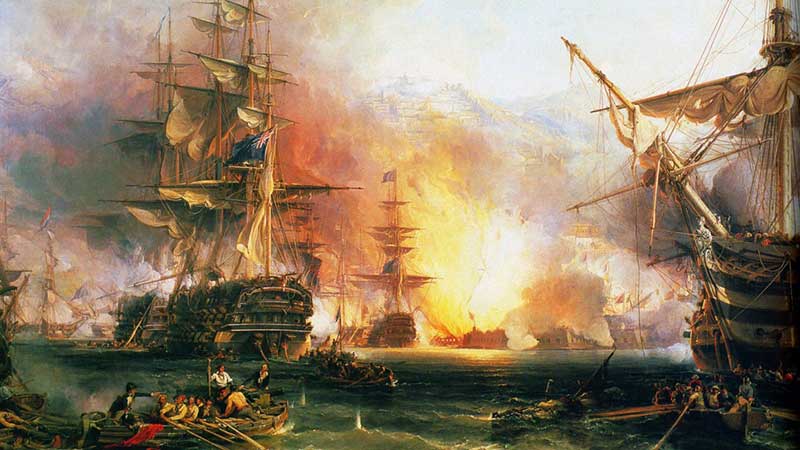
Chapter 39: The Sovereign Scale
The autumn of 1831 brought a different kind of wind to the harbor of Algiers. It
was a wind that carried the heavy, black coal-smoke of a British steam-frigate
and the elegant, white-sailed majesty of an Ottoman imperial warship.
The victory at Sidi Fredj and the rapid, silent unification of the three
provinces had sent a shockwave through the courts of Europe and the Levant. The
"Barbary Regency," which the Western powers had spent three centuries mapping as
a nest of pirates and the Ottomans had treated as a distant, troublesome colony,
had suddenly revealed itself as a disciplined, industrial state.
Amine stood by the sea windows of the grand Diwan in the Casbah, his hand
resting on the marble sill. In the harbor below, the ninety-gun captured French
ship Provence, now flying the green-and-gold lion flag of the Algerian Empire,
sat anchored beside the British frigate HMS Carron and the Ottoman warship
Selimiye.
"The envoys are here, Yusuf," Amine said, his voice quiet, his eyes watching the
small rowboats carrying the diplomats toward the harbor steps. "They have come
to see if the rumors are true. The Ottomans want their tribute; the British want
their markets; and both want to see if we are strong enough to keep what we have
taken."
Yusuf adjusted his gray wool uniform vest, his hand resting on the hilt of his
sword. "The Janissaries are whispering, Sidi. They say we must bow to the
Sultan's envoy. They fear the wrath of the Caliph."
"The Caliph has no army to spare, Yusuf," Amine said. "He has lost Greece, his
fleet was destroyed at Navarino, and his treasury is empty. He cannot force us
to pay a single copper. We will receive his envoy with the respect due to the
head of our faith, but we will not give him our sovereignty."
The meeting with the Ottoman envoy, Reshid Pasha, was conducted with a majestic,
solemn formality.
Reshid Pasha was a tall, elegant diplomat of the old school, his silk robes
embroidered with silver thread, his long beard white as wool. He entered the
marble hall of the Diwan with the slow, measured stride of a man who believed
the entire world was merely a province of the Sublime Porte.
"Sultan Amine," Reshid Pasha said, his Arabic formal and carrying the heavy,
nasal accent of the Constantinople court. "The Sultan-Caliph, Mahmud II, has
received the news of your victory over the French infidels with great joy. He
has sent me to confirm your title as the Beylerbey of Algiers, and to receive
the three years of arrears of the imperial tribute."
Amine stood before his father's old throne, but he did not sit. He walked down
the marble steps until he was level with the envoy, his posture straight, his
hand resting on his dagger.
"I thank the Sultan-Caliph for his prayers, Reshid Pasha," Amine said, speaking
in the clean, classical Arabic of the scholars. "But the Regency of Algiers is
no more. We have shed our own blood to defend this land from the French, and we
have built our own foundries without a single piastre of gold from
Constantinople. We are no longer a province. We are the Sultanate of Algeria."
Reshid Pasha's eyes narrowed, his hand tightening on his silk sash. "You refuse
the tribute, Sultan? Have you forgotten that your father's authority was granted
by the seal of the Sultan?"
"My father's authority was granted by the Janissaries, and his power was broken
by the French blockade," Amine said, his voice flat and hard. "We have built a
new power—a power of steel, steam, and wire. We do not pay tribute to those who
cannot protect us."
He signaled Yusuf, who stepped forward carrying a heavy cedarwood box.
"I do not send tribute, Mohand," Amine said, using the formal name of the
treaty. "But I send a gift of respect to the Caliph of Islam."
He opened the box.
Inside lay ten of their new Sabaa rifles, their steel barrels clean, their
walnut stocks oil-finished; three copper boxes containing five hundred of the
smokeless guncotton cartridges; and a heavy, cast-silver plate carrying one
hundred of the pure Sabaa Silver dinars.
"Tell the Sultan-Caliph," Amine said, "that we are his brothers in faith. We
will coordinate our fleets to defend the Muslim seas, and we will protect his
merchants in our ports. But our laws are our own, our coins carry our own seal,
and our borders are closed to his Janissaries. This is the Treaty of Fraternal
Alliance."
Reshid Pasha looked at the rifles, then at the heavy, brilliant silver coins
that carried the lion emblem of the new empire. He was a diplomat; he knew that
Constantinople had no fleet and no army capable of crossing the sea to enforce a
tribute that Amine's rifles could deny.
Slowly, the old envoy bowed his head, his hand rising to his turban in a gesture
of respect.
"The Sultan-Caliph will accept your fraternal alliance, Sultan Amine," Reshid
Pasha said, his voice dropping to a quiet, realistic tone. "A brother who has
steel is better than a subject who has nothing but empty pockets."
The negotiations with the British envoy, Sir Robert Gordon, were conducted the
next morning.
Gordon was a sharp, practical Scot with pale blue eyes and a mouth that seemed
frozen in a permanent, calculating smile. He had spent ten years representing
British interests in Constantinople and Vienna, and he had arrived in Algiers
expecting to meet a naive, regional despot whom he could easily manipulate into
signing an unequal trade treaty.
He entered the Casbah room, his eyes instantly scanning the walls. He saw the
pendulum water clock ticking on the wall; he saw the telegraph key on the table;
and through the window, he saw the straight, gray line of the macadam road
running along the harbor.
"You have built a remarkable house here, Sultan," Gordon said, speaking in a
slow, precise English. "In London, they told me I would find a nest of pirates.
But I see you have the McAdam roads and the telegraph. It is... unexpected."
"We are not pirates, Sir Robert," Amine said, his English fluent, clean, and
carrying the precise vocabulary of his modern engineering memories. "We are an
industrial nation. And we have no need for your protection, nor do we have any
fear of your ships."
Sir Robert Gordon blinked, his pale eyes widening in surprise at the purity of
the prince's English and the cold, Adam Smith-like clarity of his tone. He
cleared his throat, reaching into his leather dispatch-case to pull out a sheet
of heavy parchment.
"My government," Gordon said, "wishes to establish a treaty of friendship and
commerce with the Sultanate of Algeria. We ask for the 'most favored nation'
status for our merchants, a flat three-percent tariff on all British imports,
and the right for our citizens to buy land and establish trading houses in your
ports under our own laws."
It was the classic "capitulation" treaty—the unequal agreements that the
European powers had used to colonize and exploit the Ottoman Empire and China,
turning their economies into dependent resources for Western factories.
Amine took the parchment, his eyes scanning the lines with a rapid, professional
speed.
"I cannot sign this, Sir Robert," Amine said, sliding the document back across
the table.
Gordon's smile did not waver. "And why not, Sultan? It is a treaty of mutual
benefit. Our factories in Manchester and Birmingham can supply you with all the
machinery, the cloth, and the coal you need to build your country."
"It is a treaty of economic submission, Sir Robert," Amine said, his voice flat
and hard. "You ask for a three-percent tariff, which would allow your cheap,
machine-made goods to flood our markets, destroying our local weavers and our
metalworkers. You ask for extraterritoriality—for your citizens to be exempt
from our laws. No sovereign nation can accept such terms."
He stood up, walking to the large map of the Algerian resources on the wall.
"We will negotiate on the scale of absolute reciprocity," Amine said. "First:
the tariff on all British imports will be fifteen percent, and the same tariff
will apply to our exports to your ports. Second: no British merchant may buy
land in our territory; any trading house must be established as a joint-venture,
owned fifty-one percent by our citizens and forty-nine percent by yours."
He looked at Gordon, his eyes cold and unyielding.
"Third: we will not buy your finished cloth or your cheap cutlery. But we will
trade our high-purity iron ore from the Ouenza mines and our copper from the
Soummam in exchange for your precision machine tools—your gear-cutting engines,
your iron planers, and your heavy steam-hammers. We will trade raw materials for
the machines that build machines."
Sir Robert Gordon stared at the young Sultan. He felt as if he were negotiating
not with a Muslim prince in the Casbah of Algiers, but with a hard-nosed
industrialist in the boardrooms of Glasgow or Manchester. He realized that this
man understood the physics of trade as well as he understood the physics of the
steam engine.
"You are a difficult man to trade with, Sultan," Gordon said, his smile turning
into a genuine, if reluctant, look of respect.
"I am a man who intends to keep his country independent, Sir Robert," Amine
said. "We have the iron, and we have the steel. If you do not want to trade your
machinery for our ore... we will find our own way to build the tools."
Gordon stood up, reaching for his pen. "My government will accept your terms,
Sultan. A stable, industrial Algeria is a better buffer against French ambitions
in the Mediterranean than a weak colony. Let us sign the treaty."
The Treaty of Algiers was signed on September 1, 1831.
Algeria was officially recognized as a modern, sovereign, and economically
independent empire by the greatest naval power in the world. The diplomatic
circle was complete. Amine had secured his borders, stabilized his currency, and
established his trade on his own terms.
The Sultanate of Algeria was no longer a target; it was a partner, its future
locked into the steady, relentless march of its own machinery.
End of Chapter