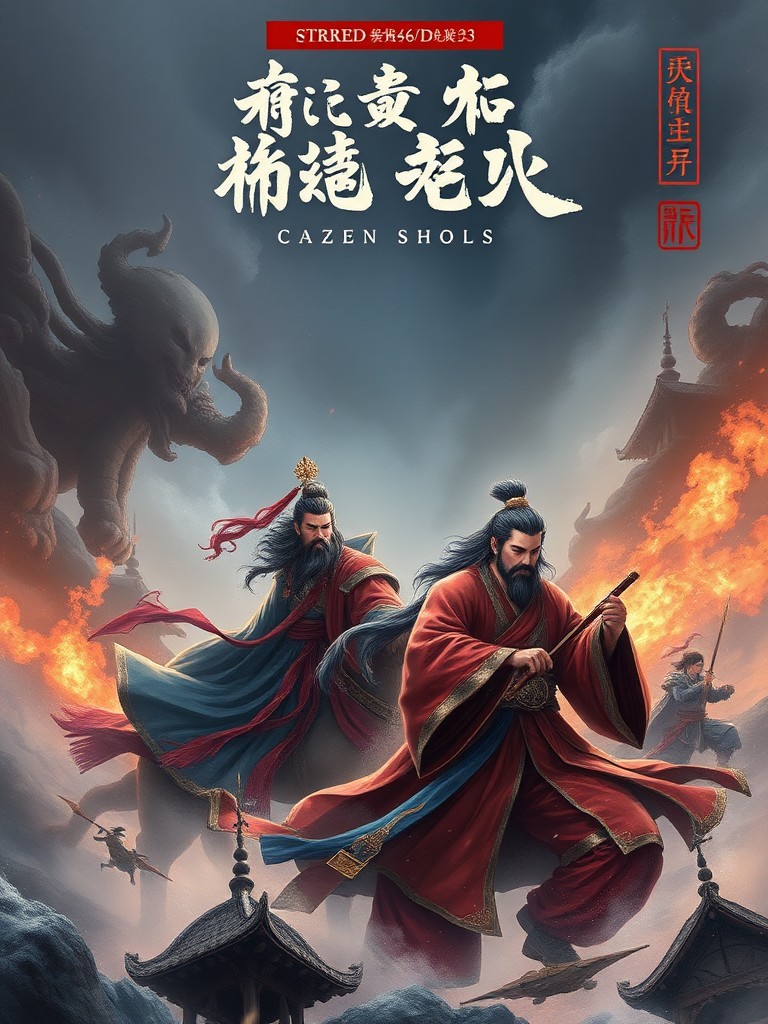
Chapter 1511
The rout of the Cao Wei army was like a sudden storm, sweeping through the originally high-morale Wei army camp. Although Sima Yi was resourceful, facing this sudden change, he had to admit the difficulty of the situation. He urgently gathered the remnants, attempting to stabilize his footing, but the continuous fierce fighting and the addition of Eastern Wu reinforcements had already made the Wei army exhausted and their morale low.
Seeing this, Jiang Wei did not immediately pursue but chose to consolidate the defense line to ensure that the occupied territory was stable. He knew deeply that although this battle was a great victory, Cao Wei had a deep foundation; if he was too eager for success, he feared there would be future worries. Thus, he ordered the troops to rest and reorganize, while strengthening patrols in the surrounding areas to prevent a counterattack by the remaining forces of Cao Wei.
Upon learning the good news from the front lines in Chengdu, Liu Chan was overjoyed and immediately ordered the commendation of Jiang Wei and all the soldiers, and personally went to the Chancellor's Office to discuss follow-up strategies with Jiang Wan. Jiang Wan proposed that they should take this opportunity to strengthen the alliance with Eastern Wu, jointly defend against Cao Wei, and at the same time develop internal affairs to enhance national strength to prepare for any unexpected needs. Liu Chan deeply agreed and sent envoys to Eastern Wu again to consolidate the friendly relationship between the two countries and requested more support from Eastern Wu in military terms.
On the Eastern Wu side, Sun Quan congratulated Shu Han on its victory and promised to provide more supplies and military support to jointly counter Cao Wei. Sun Quan knew deeply that in the tripartite confrontation, the weakening of any side could lead to the breaking of the balance, which would be unfavorable to Eastern Wu. Therefore, he decided to increase support for Shu Han to jointly resist the threat from the north.
After obtaining support from Eastern Wu, Shu Han's military power was further enhanced. Jiang Wei utilized this opportunity to begin planning a further counterattack against Cao Wei. He dispatched scouts deep into Cao Wei's hinterland to scout the enemy situation, while strengthening the training of soldiers to improve the army's combat effectiveness.
Several months later, when Cao Wei had not yet fully recovered from the shadow of the last defeat, Jiang Wei led his army to attack again, with the target pointing directly at Cao Wei's important stronghold—Chang'an. This move was intended to disrupt Cao Wei's strategic deployment, forcing them to disperse their forces and reduce the pressure on Shu Han's borders.
On the Cao Wei side, upon learning of Jiang Wei's actions, Sima Yi immediately gathered a large army to meet the battle. However, due to the previous major defeat, the morale and combat effectiveness of the Cao Wei army were greatly reduced, coupled with the tactics carefully planned by Jiang Wei, which made the Wei army suffer repeated defeats in battle. Although Sima Yi tried his best, he still could not stop Jiang Wei's offensive.
In the Battle of Chang'an, Jiang Wei once again demonstrated his military talent. He utilized the advantages of terrain and troop strength to carry out multiple ambushes and encirclements against the Wei army, making the Wei army suffer heavy losses. In the end, under Jiang Wei's fierce offensive, the Wei army had to abandon Chang'an and retreat to defend Luoyang.
The loss of Chang'an was a major blow to Cao Wei. Sima Yi was blamed by the court because of this, but he was not discouraged; instead, he began to set about rectifying the army, strengthening defense, and preparing to meet Shu Han's next attack. At the same time, he also began to seek reconciliation with Eastern Wu, attempting to break the alliance between Shu Han and Eastern Wu to reduce external pressure.
However, the alliance between Shu Han and Eastern Wu was not easily broken. Under the joint efforts of Jiang Wei and Eastern Wu generals, the cooperation between the two countries became even closer. They jointly formulated strategic plans against Cao Wei, preparing to deal Cao Wei a heavier blow in the coming battles.
As time passed, the war between the three kingdoms became increasingly fierce. Cao Wei, Shu Han, and Eastern Wu were all constantly adjusting their strategies, attempting to gain an advantage in this protracted war. However, no matter how the war developed, one thing was certain: only those generals and countries that could accurately judge the situation and flexibly respond to changes could remain invincible in this war.
Jiang Wei played a crucial role in Shu Han's military actions. He was not only brave and good at fighting but also resourceful. He knew deeply the cruelty and complexity of war, so he always acted cautiously, striving to achieve the greatest victory with the smallest cost. Under his leadership, the Shu Han army gradually grew into one of the most combat-effective forces among the three kingdoms.
And although Sima Yi suffered repeated defeats in the contest with Jiang Wei, he did not give up because of this. He constantly learned and summarized, attempting to find a way to defeat Jiang Wei. His tenacity and perseverance made Cao Wei always maintain a certain competitiveness in the war.
However, war is not just a contest between generals, but a contest of national strength and the hearts of the people. Under Jiang Wei's leadership, Shu Han not only enhanced its military power but also had a stable domestic political situation and the support of the people. This gave Shu Han more advantages in the war.
Amidst the continuous flames of war, the pattern of the Tripartite Confrontation became increasingly delicate and tense. The alliance between Shu Han and Eastern Wu was like a double-edged sword, being both a powerful threat to Cao Wei and the cornerstone of the two countries' own stability and development. The close cooperation between Jiang Wei and Eastern Wu generals was not only reflected in coordinated combat on the battlefield but also deepened into joint planning at the strategic level. They knew deeply that to achieve final victory in this long war, they must maintain a high degree of tacit understanding and trust to jointly deal with various challenges from Cao Wei.
After consolidating the occupation of Chang'an, Jiang Wei did not rush to expand the results. He deeply realized that war is not just a contest of military power, but a manifestation of a country's comprehensive strength and the direction of the people's hearts. Therefore, he began to set about rectifying Shu Han's internal affairs, improving agricultural production, and strengthening people's livelihood construction to stabilize the rear and provide a steady stream of supplies and manpower support for the war at the front. At the same time, he also strengthened economic and cultural exchanges with Eastern Wu, promoted trade between the two countries, and further consolidated the foundation of the alliance.
Under Jiang Wei's careful governance, Shu Han's national strength gradually became powerful, and the army's combat effectiveness was also significantly improved. He knew deeply that to completely defeat Cao Wei, he must find a suitable opportunity to launch a decisive battle. Thus, he began to pay close attention to Cao Wei's dynamics, looking for their weaknesses and flaws.
At the same time, Sima Yi also carried out a series of reforms and rectifications within Cao Wei. He knew deeply that he had suffered repeated defeats in the contest with Jiang Wei, but he was not discouraged because of this. On the contrary, he became even more determined to defeat Jiang Wei and unify the three kingdoms. He began to strengthen the training and equipment of the army, improving the soldiers' combat effectiveness and morale. At the same time, he also strengthened ties with northern ethnic minorities, attempting to borrow their power to counter the alliance between Shu Han and Eastern Wu.
However, Sima Yi's reforms and rectifications could not quickly change Cao Wei's unfavorable situation in the war. The alliance between Shu Han and Eastern Wu remained powerful, while Cao Wei's internal problems emerged one after another. Sima Yi knew deeply that to achieve victory in this war, he must find a new breakthrough.
Just then, an unexpected piece of news arrived: a coup occurred within Eastern Wu, and the newly ascended monarch's attitude toward Shu Han underwent a subtle change. Sima Yi keenly captured this change and decided to take this opportunity to sow discord between Shu Han and Eastern Wu, destroying their alliance.
Thus, Sima Yi began to secretly dispatch envoys to Eastern Wu, attempting to reach some kind of tacit understanding or agreement with the new Eastern Wu monarch. However, his move did not go as planned. Jiang Wei had already anticipated Sima Yi's conspiracy and made preparations in advance. He dispatched secret agents to infiltrate Eastern Wu, closely monitoring its internal dynamics, and timely informed Eastern Wu generals of Sima Yi's conspiracy.
Under Jiang Wei's reminder, Eastern Wu generals maintained a high degree of vigilance and did not easily believe Sima Yi's bait. They continued to maintain a close alliance with Shu Han, jointly dealing with the threat from Cao Wei. At the same time, they also strengthened the suppression and pacification of the internal coup, ensuring Eastern Wu's stability and unity.
After Sima Yi's conspiracy was exposed, he did not give up. On the contrary, he began to gather troops even more crazily, preparing to launch a comprehensive offensive against Shu Han. However, his move did not go as planned. Jiang Wei had already made full preparations; he led the Shu Han army to meet Sima Yi's large army, and both sides engaged in a fierce contest on the battlefield.
After several days of fierce fighting, the Shu Han army under Jiang Wei's leadership achieved victory. Sima Yi's large army was routed and fled, suffering heavy losses. This victory not only consolidated Shu Han's dominant position in the war but also further enhanced the confidence and determination of the Shu Han and Eastern Wu alliance.
End of Chapter