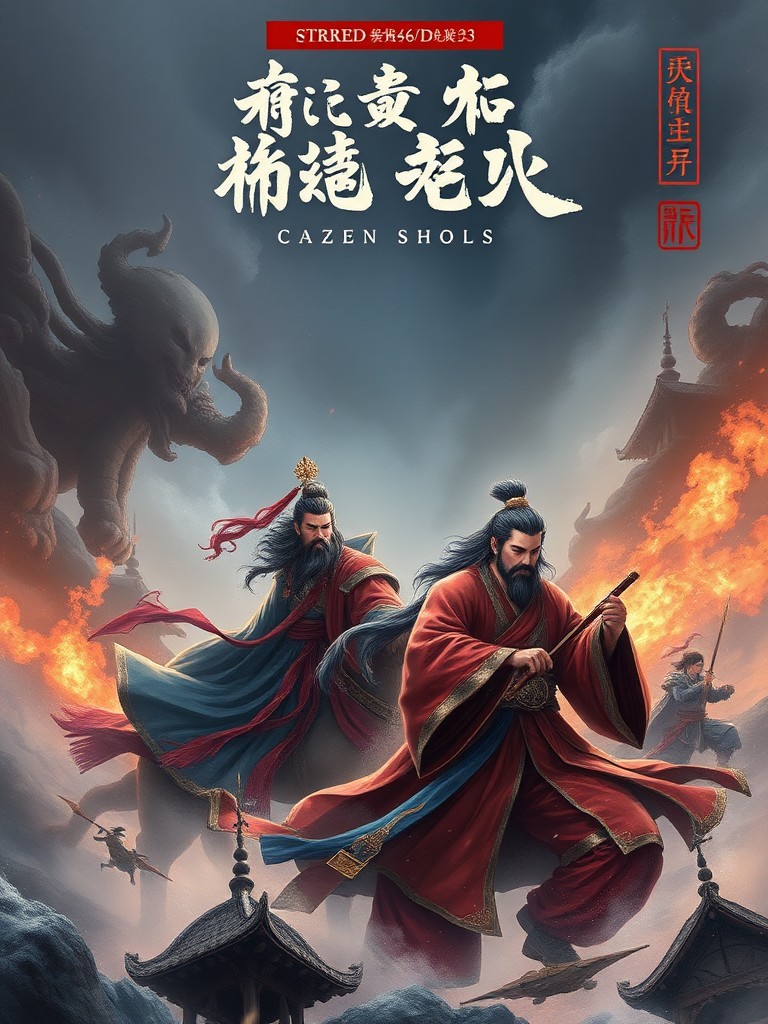
Chapter 1523: Overwhelming Advantage
The in-depth adjustment of strategic deployment made Jiang Wei understand even more that a temporary victory could not ensure long-term peace. He began to make more refined layouts at the tactical level, while also making full preparations in politics and logistics.
He knew deeply that the victory of war did not depend solely on bravery on the battlefield, but even more on the stability of the rear and the sufficiency of resources.
In order to alleviate the pressure brought by Shu Han's weakening national strength, Jiang Wei began to actively promote the policy of military agricultural colonies, encouraging soldiers and common people to reclaim wasteland and plant grain during the intervals of war to ensure the army's grain supply.
At the same time, he also strengthened ties with surrounding ethnic minorities, exchanging for a large number of warhorses and supplies through mutual trade, further enhancing Shu Han's military strength.
In military deployment, Jiang Wei adopted more flexible strategies. He no longer relied solely on tactics like night raids and surprise attacks, but began to focus on the construction of positions and the building of defensive fortifications. He utilized the advantage of Shu Han's mountainous terrain to build multiple defensive lines, forming a posture of layered resistance. Whenever the Cao Wei army launched an offensive, they would encounter stubborn resistance on these lines, thus unable to advance rapidly.
At the same time, Jiang Wei also strengthened intelligence work, dispatching spies to infiltrate Cao Wei territory to spy on military intelligence and understand the enemy's movements. This allowed him to make predictions in advance and formulate more precise tactics. In many battles, Jiang Wei successfully predicted the movements of the Cao Wei army based on accurate intelligence, thereby gaining the initiative in battle.
However, despite Jiang Wei's tremendous efforts in tactics and strategy, Shu Han's political situation remained turbulent. Zhuge Liang's critical illness caused Shu Han's political landscape to fall into unprecedented chaos. Various factions in the court began to fight openly and secretly for power. This internal strife undoubtedly brought huge trouble to Jiang Wei's military operations.
In order to stabilize the morale of the army, Jiang Wei had to frequently travel between the front line and the rear to communicate and coordinate with the ministers in the court. He tried hard to persuade all factions to prioritize the big picture and jointly resist Cao Wei. Under his unremitting efforts, Shu Han's political situation finally gradually stabilized, and the strife in the court was effectively contained.
Just at this moment, unexpected news arrived: a major change had also occurred within Cao Wei. The Emperor of Cao Wei suddenly passed away from illness, and a new emperor ascended the throne, but he was young and ignorant, and the power of the court fell into the hands of powerful officials. This caused Cao Wei's political situation to also fall into chaos, and the combat effectiveness of the army was severely affected.
Jiang Wei keenly captured this opportunity; he decided to seize the chance to launch a large-scale offensive to defeat Cao Wei in one fell swoop. He gathered the generals, formulated a detailed combat plan, and personally led the army to launch a fierce attack on Cao Wei's territory.
In this battle, Jiang Wei fully displayed his military talent. He utilized the chaos within Cao Wei to successfully break through the enemy's defensive lines and capture multiple important cities. Under Jiang Wei's fierce offensive, the Cao Wei army's morale was low, and they retreated step by step. Finally, in a decisive battle, the Shu Han army defeated the Cao Wei army with an overwhelming advantage and achieved victory in the war.
This victory not only preserved the empire of Shu Han but also brought Jiang Wei's reputation to its peak. He became a hero in the hearts of the people of Shu Han and was honored as the "God of War." However, Jiang Wei was not satisfied because of this.
After achieving that decisive victory, Jiang Wei did not immerse himself in the joy of victory for too long; he knew deeply that true peace required a more solid foundation. Although Cao Wei was temporarily routed, its roots were deep, and it could make a comeback at any time. Therefore, Jiang Wei decided to pursue the victory, utilize the current favorable situation to further expand the results, and thoroughly weaken Cao Wei's power.
He first consolidated the newly occupied territory, dispatched capable civil and military officials to govern, and simultaneously implemented a series of policies to appease the people, such as reducing taxes, opening granaries to distribute grain, and building water conservancy projects, quickly winning the support and backing of the local people. These measures not only stabilized the new territory but also provided Shu Han with a continuous supply of materials and manpower.
Next, Jiang Wei formulated a bold strategic plan—striking directly at the heart of Cao Wei, invading its hinterland, and directly threatening its capital. This plan was bold and risky, but Jiang Wei firmly believed that only by thoroughly crushing Cao Wei could Shu Han's long-term safety be ensured. He personally led an elite force, crossed steep mountains and rivers, avoided the areas heavily defended by Cao Wei, and penetrated deep into Cao Wei's hinterland with lightning speed.
On the Cao Wei side, due to internal power struggles and continuous defeats, morale was low, and the defense system was full of loopholes. When Jiang Wei's army suddenly appeared before their eyes, they were almost completely unprepared. Jiang Wei utilized this advantage to launch continuous fierce attacks, sweeping away everything in his path, capturing multiple important cities of Cao Wei in succession, and pressing directly toward its capital.
The Cao Wei court was in chaos; the new emperor and the powerful officials were at their wits' end and could only hurriedly gather the remaining troops, attempting to stop Jiang Wei's offensive. However, at this time, the Shu Han army, under Jiang Wei's leadership, had already transformed into an unstoppable torrent of steel. They were invincible on the battlefield, whether it was a frontal charge or a surprise attack on the flanks, displaying astonishing combat effectiveness and tacit cooperation.
In one fierce battle after another, Jiang Wei personally went into battle, setting an example and inspiring every soldier. His bravery and wisdom became the spiritual pillar of the Shu Han army. Under his leadership, the soldiers fought bravely, unafraid of death, displaying an astonishing will to fight.
As the front line continuously advanced, Cao Wei's defense system gradually collapsed. Their army suffered heavy losses in continuous battles, and their morale dropped to the extreme. Meanwhile, the Shu Han army's morale was high, and their combat effectiveness became stronger and stronger. In this one-sided situation, Cao Wei's defeat and destruction were already inevitable.
Finally, Jiang Wei led the Shu Han army into the capital of Cao Wei. In this battle, Jiang Wei fully displayed his military talent and strategic vision. He utilized the advantages of terrain and troop strength to successfully break through Cao Wei's defensive lines and capture important areas of the capital. Under Jiang Wei's fierce attack, the Cao Wei army collapsed one after another, unable to resist.
With the fall of the capital, Cao Wei's rule thoroughly collapsed. Their emperor and powerful officials were either captured or fled to other lands. The Cao Wei army also lost its will to fight and surrendered or disbanded one after another. Almost the entire territory of Cao Wei fell into the hands of Shu Han.
This one-sided battle not only displayed Jiang Wei's outstanding military talent and strategic vision but also highlighted the bravery and combat effectiveness of the Shu Han army. In this battle, they thoroughly defeated Cao Wei with an overwhelming advantage and achieved an unprecedented victory.
However, for Jiang Wei, this victory did not just mean military success. He valued even more that through this victory, long-term peace and stability were won for Shu Han. He knew deeply that only true peace could allow the people to live and work in peace and contentment, and allow the country to be prosperous and strong.
Therefore, after the victory, Jiang Wei did not stop his pace of advancement. He began to work on post-war reconstruction, repairing the damage caused by the war, and restoring production and the order of life. He implemented a series of policies conducive to the country's development, such as encouraging farming, building water conservancy, and reducing taxes; these policies greatly promoted Shu Han's economic development and social progress. ===== CHAPTER 1524 =====
End of Chapter