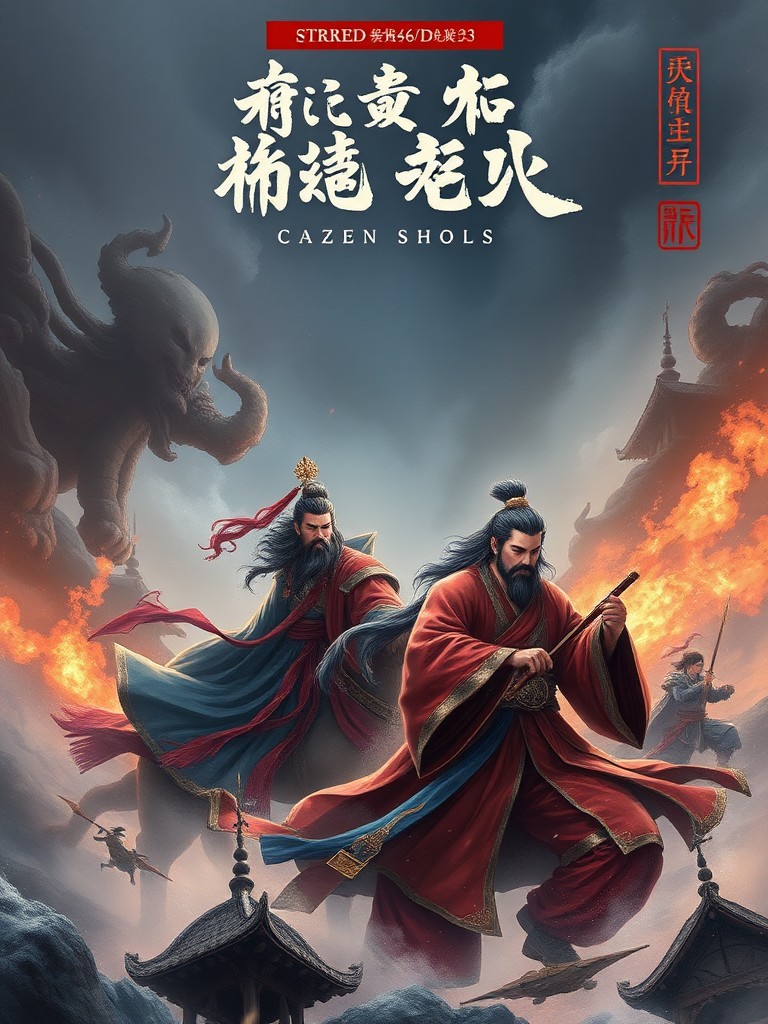
Chapter 1585: A Thorough Rout
A fire suddenly broke out in the rear of the Cao Army, causing panic among the soldiers on the front lines and severely impacting morale. Seeing this, Cao Cao was consumed by rage, yet he was helpless. He could only order a portion of his troops to go and fight the fire, while the others continued to grapple with Gu Yi's army.
However, Gu Yi's strategy went far beyond this. Seeing the Cao Army split its forces to fight the fire, he immediately commanded his main force to launch a fierce assault, tearing a massive gap in the Cao Army's front line. Although Cao Cao's personal guards were valiant, they gradually found themselves overwhelmed under the violent offensive of Gu Yi's army.
At this critical moment, Gu Yi personally led his troops into the enemy formation, engaging in a life-or-death struggle with Cao Cao's personal guards. Both men were highly skilled in martial arts and possessed extraordinary strategic minds; this battle was not merely a contest between armies, but a duel between two leaders.
Amidst the flashing blades and shadows, Gu Yi and Cao Cao traded blows, locked in an inseparable struggle. The surrounding soldiers joined the fray one after another, cheering for their respective leaders. Throughout the entire valley, the sounds of killing shook the heavens, and blood flowed like a river; it was as if the valley had become a living hell.
After a fierce battle, Gu Yi finally relied on his superior martial arts and extraordinary strategy to defeat Cao Cao's personal guards, forcing Cao Cao into a desperate situation. Seeing that the situation was lost, Cao Cao had no choice but to retreat, fleeing the valley with his remnants and defeated troops.
Seeing Cao Cao retreat, Gu Yi did not immediately pursue. Instead, he ordered his army to rest and reorganize on the spot, preparing to meet a potential counterattack. He knew that although Cao Cao had been defeated, his strength remained, and one could not afford to be careless.
Sure enough, not long after, Cao Cao gathered his remaining forces and launched another attack on Gu Yi. However, this time, Gu Yi was well-prepared. He utilized the terrain to his advantage, setting up layers of traps that repelled Cao Cao's army time and time again.
After several clashes, Cao Cao's army suffered heavy losses, and morale plummeted. Gu Yi's army, meanwhile, was in high spirits, their combat effectiveness growing ever stronger. Ultimately, through Gu Yi's meticulous planning and the heroic fighting of his soldiers, Cao Cao's army was thoroughly routed and forced to withdraw from Jingzhou.
After this battle, Gu Yi's prestige soared, and he became a standout figure in Jingzhou and even the entire Central Plains region. Cao Cao, having suffered a major blow to his vitality, had to temporarily abandon the struggle for Jingzhou and turn to consolidating his power in the north.
After defeating Cao Cao, Gu Yi did not immediately press his advantage. Instead, he chose to recuperate and consolidate his victory. He knew well that while war could bring temporary victory and glory, true peace and prosperity required long-term effort and governance.
Thus, Gu Yi began to reorganize the army, restore production, develop the economy, and improve the people's livelihood. He implemented a series of reforms that allowed the Jingzhou region to gradually recover its former prosperity and tranquility. At the same time, he actively engaged with surrounding factions, expanding his influence and laying the foundation for a future grand unification.
Cao Cao, after his retreat, was not discouraged. Knowing the gap in strength between himself and Gu Yi, he began to reorganize his army, strengthen training, and improve combat effectiveness. At the same time, he actively sought the support of allies, aiming for a comeback.
After several years of preparation and accumulation, Cao Cao's strength gradually recovered, and he once again turned his gaze toward Jingzhou and Gu Yi. However, Gu Yi was no longer the man he once was; he had not only achieved great success militarily but had also made significant progress in politics, economics, and culture. Cao Cao knew that to defeat Gu Yi, he would have to pay a much higher price and exert greater effort.
Thus, Cao Cao began planning a larger-scale war, attempting to defeat Gu Yi in one stroke and unify the Central Plains. However, this war was not as simple as he had imagined. Gu Yi had long since sensed Cao Cao's intentions and had begun preparing countermeasures.
Cao Cao knew that if he lost this battle, he might never have a chance to rise again; Gu Yi, likewise, understood the importance of this campaign, as it concerned the stability and future of Jingzhou and the entire south. Therefore, both sides poured in all their strength, mobilizing their most elite troops and preparing the most comprehensive strategies.
Before the battle, Cao Cao summoned all his advisors and generals for an unprecedented military conference. At the meeting, he proposed a bold plan—to utilize the advantages of terrain and troop numbers to divide and encircle Gu Yi's army, then destroy them one by one. Though risky, if successful, this plan would turn the tide of the war in one stroke.
Guo Jia, Cheng Yu, and other advisors discussed and refined this plan in depth, eventually forming a detailed operational scheme. Cao Cao was full of confidence, believing that as long as the plan was executed properly, victory would surely belong to him.
Gu Yi, meanwhile, was not sitting idly by. He also summoned his group of advisors to conduct an in-depth analysis and prediction regarding Cao Cao's potential strategy. Upon learning that Cao Cao might adopt a tactic of division and encirclement, Gu Yi decided to adopt a flexible and mobile strategy, utilizing Jingzhou's complex terrain and abundant resources to maneuver against Cao Cao's army.
He ordered a portion of his troops to set up decoys at key locations to confuse the enemy; at the same time, he dispatched elite squads to infiltrate behind enemy lines, destroy Cao Cao's supply lines, and disrupt his rear. Additionally, Gu Yi secretly contacted friendly forces in the surrounding areas, requesting their support at critical moments.
The campaign finally erupted. Cao Cao's army surged forward like a tidal wave, attempting to swallow Gu Yi's army in one go. However, Gu Yi's army was like a loach, nimbly weaving through the battlefield and cleverly avoiding the main force of Cao Cao's attack.
Seeing this, Cao Cao was furious and ordered his army to intensify the offensive. Yet, as the battle deepened, he gradually discovered that his army seemed to have been led into a massive labyrinth. No matter how hard they tried, they could not locate the main force of Gu Yi's army.
Meanwhile, Gu Yi's elite squads launched fierce attacks behind enemy lines. They destroyed Cao Cao's grain warehouses and burned down the armories, plunging Cao Cao's army into an unprecedented predicament.
Seeing that the situation was dire, Cao Cao hurriedly ordered a retreat. However, it was already too late. Gu Yi's army, like ghosts, clung tightly to Cao Cao's army, launching continuous attacks.
After several days of fierce fighting, Cao Cao's army finally collapsed. They suffered heavy losses, morale was low, and they were forced to retreat to the north. Gu Yi's army pursued the victory, marching north all the way and recovering vast swathes of lost territory.
After this battle, Gu Yi's reputation reached an unprecedented height. He was hailed as the guardian deity of the south and became a hero in the hearts of countless people. Cao Cao, due to the failure of this battle, fell into deep self-reproach and agony.
However, Cao Cao did not let this defeat keep him down. He knew that failure was the mother of success. Thus, he began to reorganize his army, strengthen training, and improve combat effectiveness. At the same time, he actively sought the support of allies, aiming for a comeback.
After several years of effort, Cao Cao's strength gradually recovered. He once again turned his gaze toward Jingzhou and Gu Yi, his heart filled with the flames of revenge. However, Gu Yi was no longer the man he once was. He had not only achieved great success militarily but had also made significant progress in politics, economics, and culture. ===== CHAPTER 1586 =====
End of Chapter