Chapter 1591
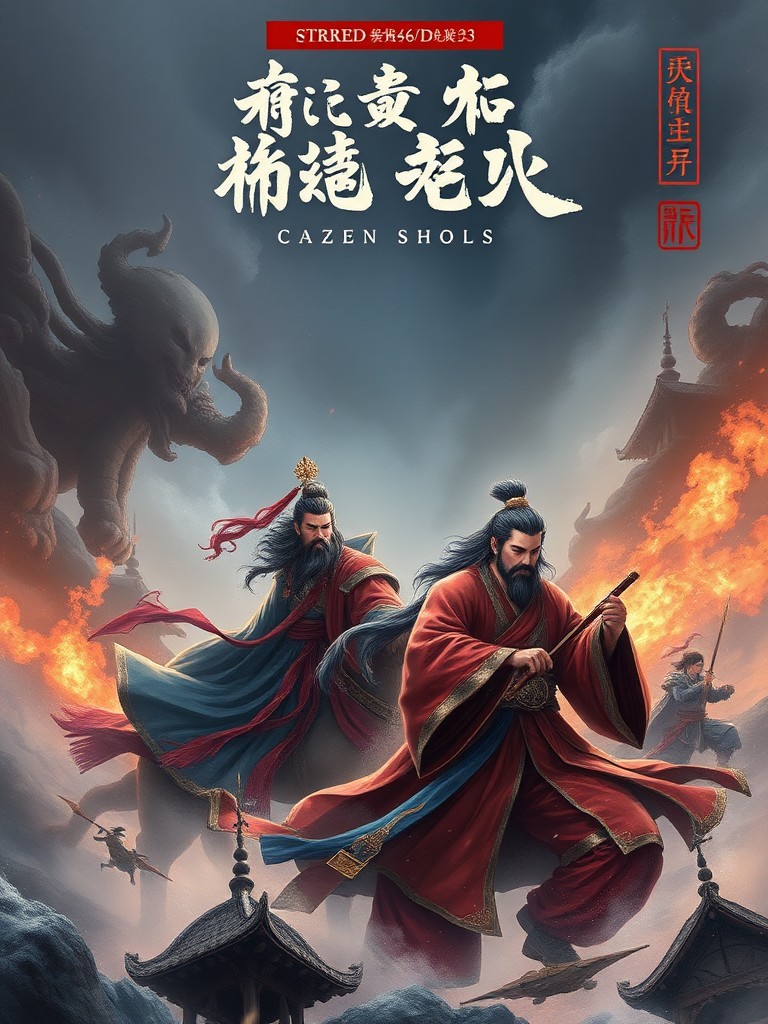
The two armies stood in confrontation on a vast plain. The sky was overcast with thick clouds, as if even the heavens felt heavy for the massive battle about to unfold. Cao Cao and Gu Yi each stood before their formations, their gazes meeting, sparks flying. The air was filled with a tense and oppressive atmosphere, and both sides were waiting for that decisive moment.
"Gu Yi, you mere commoner, to dare contend with me—truly overestimating your own strength!" Cao Cao shouted loudly, attempting to overwhelm the opponent with his presence.
Gu Yi smiled slightly, his tone calm and firm. "Cao Cao, the world is not the world of one man, but the world of all people. Though I, Gu Yi, was born in humble circumstances, I harbor great ambitions and have sworn to bring peace to this chaotic world. Today's battle is the proof."
Having said this, both sides waved their hands to give the order. War drums thundered, horns blared, and the two armies surged toward each other like a tidal wave, and thus a world-shaking battle began.
The fighting was exceptionally intense, and soldiers on both sides fought without regard for their own lives, struggling to the death. Amidst the flashing blades and shadows, flesh and blood flew, and the sounds of wailing and roaring intertwined, shaking the heart. Cao Cao and Gu Yi personally entered the fray, each displaying what they had learned, fighting in an inseparable struggle. As time passed, the outcome on the battlefield gradually became clear; Gu Yi, relying on his advantage in troop numbers and outstanding command, gradually gained the upper hand.
Seeing this, Cao Cao was anxious. He knew that if he lost this battle, his foundation of many years would likely be destroyed in one fell swoop. Thus, he decided to stake everything on one throw, personally leading an elite unit in an attempt to break through Gu Yi's defensive line and strike directly at the central command.
However, Gu Yi had long been prepared. He had anticipated that Cao Cao would do this and had already set up layers of ambushes. When Cao Cao led his troops into the ambush zone, arrows rained down from all directions, the Cao Army suffered heavy losses, and Cao Cao himself nearly lost his life.
Ultimately, in this heart-pounding massive battle, Gu Yi achieved victory with a narrow advantage. Cao Cao was forced to retreat, suffering heavy losses, and his sphere of influence shrank significantly, while Gu Yi pursued the victory, further consolidating his position.
After the battle, Gu Yi did not rush to expand. Instead, he chose to recuperate, reorganize internal affairs, and simultaneously strengthen border defenses to prevent Cao Cao from making a comeback. He knew that true peace was not achieved through war, but through wisdom and effort, gradually established step by step.
Cao Cao, having experienced this crushing defeat, also began to reflect on his strategy. He realized that relying solely on military force could not conquer the world and that it must be supplemented by strategy and benevolent governance. Thus, he began adjusting his policies, employing virtuous and talented people, and developing the economy, striving to surpass Gu Yi in internal affairs to prepare for a potential future decisive battle.
As time passed, the confrontation between Gu Yi and Cao Cao entered a state of subtle balance. Gu Yi dedicated himself to domestic construction and development; he knew that the strength of a country lay not only in a powerful army but also in the people living and working in peace and contentment. Therefore, he implemented a series of policies beneficial to the people, reducing taxes, encouraging farming, and repairing water conservancy, which allowed the domestic economy to recover rapidly and the people's lives to improve day by day.
Cao Cao, meanwhile, implemented strict rule of law within his territory while not forgetting to develop the economy and enhance national strength. He knew the importance of talent, so he widely recruited virtuous scholars, regardless of their background—as long as they had talent, they could be used. This policy attracted numerous capable people, injecting new vitality into Cao Cao's hegemony.
Against this backdrop, though there were occasional frictions between the two countries, they generally maintained peace. However, this peace was only superficial; both sides knew clearly that the true contest was yet to come.
In order to better understand Cao Cao's movements, Gu Yi decided to dispatch messengers to Cao Cao's territory, ostensibly for a friendly visit, but in reality to spy on military intelligence. Cao Cao naturally understood Gu Yi's intentions, but he was also happy to accept this visit, as he likewise wanted to take this opportunity to understand Gu Yi's strength and intentions.
The messenger delegation received a warm reception in Cao Cao's territory, and both sides engaged in in-depth exchanges. During the exchanges, Cao Cao discovered that there were many talented and knowledgeable people in Gu Yi's messenger delegation, which made him rate Gu Yi even higher. Gu Yi's messengers, through this visit, also gained a deeper understanding of Cao Cao's governance philosophy and military talent.
After the visit concluded, the messengers from both sides returned to their respective countries and reported the situation to their lords. Gu Yi and Cao Cao, after listening to the reports, both fell into deep thought. They knew that the other was not an easy character to deal with; to defeat the opponent, they had to be fully prepared.
Thus, both countries began tense war preparations. Gu Yi strengthened the army's training and simultaneously implemented a series of reforms domestically to improve the country's overall strength. Cao Cao, meanwhile, conscripted troops on a massive scale within his territory and strengthened border defenses to prevent a sudden attack from Gu Yi.
However, just as both countries were busily preparing for war, a sudden natural disaster broke this balance. Years of drought led to reduced grain production, and the people lived in hardship. Gu Yi and Cao Cao both faced severe tests; they had to find a way to solve the grain problem, otherwise, the country would fall into turmoil.
Gu Yi decided to open the granaries to provide relief to the people. At the same time, he dispatched messengers to various places to promote the importance of saving grain and encouraged the people to plant drought-resistant crops to cope with the drought. This policy won the support of the people, and Gu Yi's reputation soared as a result. ===== CHAPTER 1592 =====
End of Chapter