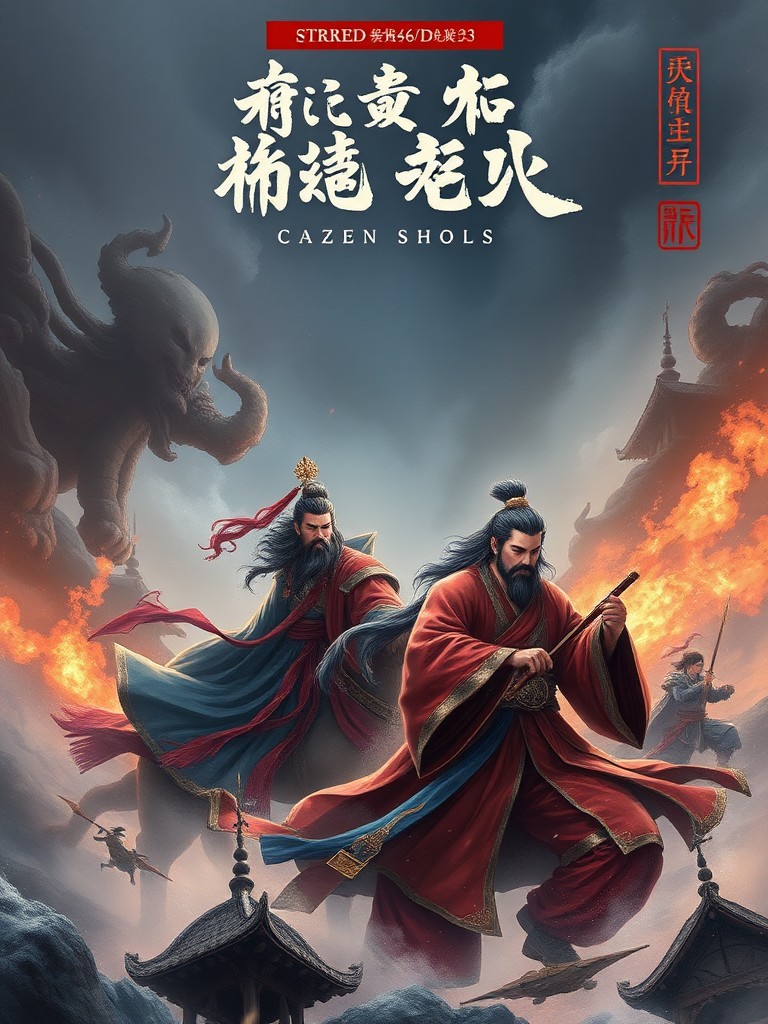
Chapter 1593: Piles of White Bones
In this sudden sandstorm, Gu Yi and Cao Cao felt once again the power of nature, as well as its mockery of this endless war. The storm was like a ruthless bystander, using its raging power to temporarily interrupt this human tragedy.
Gu Yi and Cao Cao, two former opponents, now stopped their weapons under the cover of the storm, their gazes piercing through the sky filled with yellow sand, as if searching for some kind of answer. The same thought surged in both their hearts: what was this war for? Was it for personal power, or for the interests of the country? Or perhaps, was it just to let more innocent people be buried here?
The storm gradually subsided, but the atmosphere on the battlefield became even more solemn. Gu Yi and Cao Cao, two heroes, stood face to face once again; there was less hostility in their eyes and more contemplation. They knew that this war could not continue like this and that they must find a way to resolve it peacefully.
"Cao Cao, if we continue like this, we will only cause more people to suffer." Gu Yi was the first to break the silence, his voice sounding exceptionally clear on the vast battlefield.
Hearing this, Cao Cao was silent for a moment, then slowly spoke: "Gu Yi, you are right. This war has already caused us to lose too much. To continue will only cause more innocent people to suffer."
The two heroes, at this moment, seemed to have reached a kind of tacit understanding. They decided that for the safety of the people and the future of the country, they would put aside personal grievances and jointly seek a peaceful solution.
Thus, they summoned their respective generals and conveyed this decision to everyone. When the soldiers heard this news, they all showed expressions of disbelief, but soon, they were infected by this rare sense of peace and put down the weapons in their hands, stopping the meaningless struggle.
Gu Yi and Cao Cao, two former opponents, now looked like partners working hand in hand. They patrolled the battlefield together, looking at the scars left by the war, their hearts filled with emotion. They knew that the end of this war did not mean that all problems had been solved, but they believed that as long as there was love in their hearts and a longing for peace, they would certainly be able to find a better solution.
In the days that followed, Gu Yi and Cao Cao began to govern the country together. They learned from each other and drew lessons from each other, allowing the country to gradually move toward prosperity and stability. The people lived and worked in peace and contentment, grateful for the wise decisions of Gu Yi and Cao Cao, and regarded them as heroes of the country.
However, the road to peace was not smooth. Occasionally, small disputes and conflicts would appear, but Gu Yi and Cao Cao were always able to resolve these contradictions in time, allowing the country to always remain on the track of peace and stability.
As time passed, Gu Yi and Cao Cao grew older, but their love for the country and their pursuit of peace never changed. They knew that their entire lives had been spent striving for this land and the people on this land, and this was their greatest pride and glory.
Finally, one day, Gu Yi and Cao Cao passed away one after another, but the seeds of peace they left behind took root and sprouted on this land, growing sturdily. Later generations remembered their achievements and contributions, regarding them as eternal models and examples.
After that sandstorm, the country governed jointly by Gu Yi and Cao Cao ushered in unprecedented peace and prosperity. The people lived and worked in peace and contentment, the rice in the fields was golden, merchants traveled frequently, and culture and art ushered in a new spring. However, this peace was not without cost; the piles of white bones of the soldiers who sacrificed themselves for the war became the heaviest memory on this land.
To commemorate those departed heroic spirits, Gu Yi and Cao Cao jointly decided to build a grand martyrs' cemetery in the central part of the country. The design of the cemetery integrated the wisdom of the two heroes, reflecting respect for the deceased and embodying the eternal pursuit of peace. In the cemetery, rows of tombstones were neatly arranged, each engraved with the name and life story of a martyr, allowing later generations to remember their heroism and sacrifice.
During the construction of the martyrs' cemetery, Gu Yi and Cao Cao personally supervised, ensuring that every detail was perfect. They knew that this cemetery was not only a comfort to the deceased but also a warning to later generations. Whenever the country encountered major festivals or anniversaries, they would lead officials and the people to pay their respects, commemorate the martyrs, and pray for peace.
As time passed, the martyrs' cemetery became a spiritual symbol of the country, attracting countless tourists to visit. People came here to commemorate history, feel that peace was hard-won, and cherish their current happy lives even more. At the same time, the cemetery also became an important place for educating later generations, letting children know from a young age that peace required paying a huge price and needed to be cherished and maintained by everyone.
However, the road to peace was not smooth. After Gu Yi and Cao Cao passed away, the country experienced several changes of regime, each accompanied by turmoil and unease. But no matter how the regime changed, the martyrs' cemetery always stood firm, becoming the cornerstone of the country's stability and the pillar of its spirit. Whenever the country faced a crisis, people would spontaneously gather in front of the cemetery to commemorate the martyrs, draw strength, jointly resist foreign enemies, and guard their homes.
Under the influence of the martyrs' cemetery, the country gradually formed a unique culture of peace. People advocated peace, respected life, and opposed war and violence. This culture took root in people's hearts and became an important driving force for the country's development. At the same time, the country also actively advocated international cooperation, jointly maintaining regional and world peace and stability with other countries.
In a peaceful environment, the country's economy, culture, technology, and other aspects achieved long-term development. In the fields, new farming techniques were widely applied, and grain production increased significantly; in the cities, industry and commerce were prosperous, and new industries and business models emerged one after another; in the cultural field, a hundred flowers bloomed and a hundred schools of thought contended, and various artistic schools and ideological viewpoints merged, promoting the prosperity and development of culture.
However, behind the prosperity, people never forgot the martyrs who sacrificed themselves for the war. Whenever the night was deep and quiet, there would always be people coming to the martyrs' cemetery to silently pray for the deceased and pray for peace. Those memories of piles of white bones became the eternal pain in people's hearts and also inspired people to pursue peace more firmly.
As time passed, the martyrs' cemetery gradually became a place of historical significance. It witnessed the vicissitudes of life and also witnessed people's eternal pursuit of peace. ===== CHAPTER 1594 =====
End of Chapter