Chapter 34: The Blind Grid
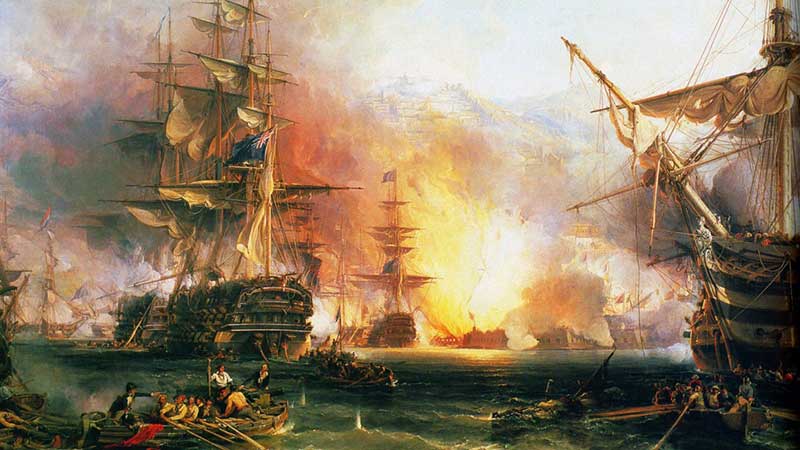
Aboard the flagship Provence, the atmosphere in the Great Cabin was suffocating.
The air was thick with the acrid, yellow stench of sulfur from the lower decks,
and the heavy oak timbers of the ship groaned under the continuous, rhythmic
recoil of the ninety-pound broadsides.
Admiral Duperré stood by the stern windows, his hand resting on the gold hilt of
his sword, looking out at the bay. The water was no longer blue; it was a gray,
stagnant mirror, completely shrouded in a dense, fog-like wall of white
gunpowder smoke that had settled over the peninsula.
"We have fired four thousand rounds, General," Duperré said, his voice flat with
exhaustion as he turned to face Bourmont. "My gunners are collapsing from the
heat, and the thirty-six-pounders are so hot the lard-grease is boiling on the
barrels. We cannot maintain this fire. We must withdraw the fleet to the deeper
waters of the outer bay to cool the guns and restock the powder rooms."
"No!" Bourmont slammed his fist down on the map table, his face flushed dark
with a desperate, manic resolve. "If we sail back to the outer bay, the news of
this failure will reach Marseille before the week is out. The liberal newspapers
will declare that the King's armada has been defeated by a handful of mountain
bandits. The Chamber of Deputies will refuse the war credits, and the King's
throne will fall before the end of the summer! We must land the third division!"
"Under that fire?" Duperré gestured to the smoking dunes of the peninsula. "It
is madness, General."
"We will use the smoke as our shield," Bourmont said, his eyes narrowing as he
looked at the white fog that covered the bay. "The enemy's snipers have proven
their reach, but they cannot shoot what they cannot see. We will order the ships
to fire a final, massive salvo of blank charges to thicken the fog, and we will
land General de Neuilly's four thousand men under the cover of that white wall.
They will land in silence, they will cross the beach unseen, and they will take
those redoubts before the prince's gunners can even lay their sights."
Duperré looked at the Minister of War for a long moment, seeing the desperate,
political terror that was driving him. He knew the risk was immense, but he also
knew that to refuse a direct order from the Minister of War on the eve of battle
was treason.
"Very well, General," the Admiral said slowly. "We will land the third division.
May the smoke protect them."
Behind the sand-filled breastworks of the center redoubt, the world was a
silent, white wilderness.
The French naval bombardment had finally ceased, leaving behind a heavy,
suffocating silence that was broken only by the low groans of the wounded on the
distant beach and the quiet, steady dripping of wet fog from the willow laths of
the gabions.
The white smoke of the French ships had settled over the entire neck of the
peninsula, so thick and dense that Amine could not see his own horsemen twenty
paces away.
"Sidi," Yusuf said, stepping into the redoubt, his face pale under his gray wool
hood, his hand holding a wet cloth over his nose to filter the sulfurous air.
"The water is gone. The smoke is too thick. We cannot see the bay, and we cannot
see the landing channels. If they send their flat-boats now, we will not know
they are here until their bayonets are at our throats."
Amine did not look at the fog. He stood before a large, flat brass plate that
had been bolted to the oak platform of the center gun—a plotting board.
The board was engraved with a precise geometric grid. It was a map of the bay of
Sidi Fredj, divided into thirty small squares, each marked with a Roman numeral.
From the center of the board, a series of brass pointer-arms, like the hands of
a clock, extended to the outer edges, their positions calibrated to the exact
traversing gears and elevating screws of the six Zilzal cannons.
"We do not need our eyes, Yusuf," Amine said, his voice calm, flat, and carrying
the absolute authority of a mathematician. "The French flat-boats are heavy,
wooden craft. Because of the shallow reefs and the sandbars in this bay, they
cannot choose their own path. They must follow the three narrow channels of deep
water to reach the beach."
He tapped the brass plate.
"During the winter, I mapped these channels to within a single meter of
accuracy. I know the exact distance and the exact angle of every square of this
water-grid from this redoubt. If they are in the smoke, they are still on the
grid."
He turned to the telegraph key, his fingers pressing the brass lever to send his
command to Meziane at the old fort's lookout post.
Click... clink... click.
"Meziane," Amine's signal read. "The French are landing under the smoke. Listen
for the sound of their oars. Tell me which channel they are using."
Two miles away, at the tip of the peninsula, Meziane stood on the high stone
gallery of the old fort. The smoke was slightly thinner here, the sea-breeze
keeping the white fog from settling too tightly around the rocks.
He knelt, his ear pressed against a long, hollow copper tube he had driven into
a crevice in the stone gallery—a primitive but highly effective acoustic
hydrophone Amine had designed to capture the sound of the water.
He listened.
Through the copper tube, the quiet of the sea was broken by a rhythmic, metallic
splash-creak... splash-creak. It was the sound of hundreds of heavy wooden oars
striking the water simultaneously, their cadence slow, steady, and heavy.
"They are in the western channel," Meziane muttered, his hand instantly reaching
for his telegraph key.
Click... click... clank.
In the center redoubt, the needle of Amine's receiver clicked.
"They are in the western channel, Sidi," Yusuf said, reading the translation
from his notebook. "Square nine."
Amine did not hesitate. He turned to the brass plotting board, his fingers
sliding the brass pointer-arm until it locked into the notch marked IX.
He read the numbers on the scale.
"Redoubt One and Redoubt Two," Amine called out, his voice sharp and clear over
the hum of the cooling steam engine outside. "Elevation five degrees, twenty
minutes. Traverse left three degrees, forty minutes. Load the explosive shells."
The gun crews worked with a rapid, silent precision. They did not look at the
fog; they looked at the brass scales of their guns, turning the elevating screws
and the traversing gears until the pointers matched Amine's numbers exactly.
"The guns are laid, Sidi," Lounes said, his hand ready on the percussion primer.
"Fire," Amine said.
BOOM.
The two Zilzal cannons of the western redoubt fired, their heavy, gold-bronze
barrels recoiling with a sharp, cracking roar that was muffled by the thick
smoke.
Inside the white fog of the western channel, the eighty flat-boats of General de
Neuilly's division were moving in silent, disciplined lines.
The soldiers of the 3rd Regiment sat tense, their hands gripping the gunwales,
their eyes searching the white wall of smoke ahead. They believed they were
invisible, protected by the dense cloud their fleet had created.
"Keep the stroke, men," a French lieutenant whispered from the lead boat, his
hand resting on the wooden tiller. "We are nearly there. Another hundred yards,
and we will hit the sand."
Suddenly, a high-pitched, screaming whistle tore through the white fog above
them—a sound like the tearing of silk.
"Inbound!" a soldier screamed, pointing to the sky.
Before the lieutenant could even look up, the two Zilzal shells, fired blindly
from two miles away with mathematical precision, struck the center of the
landing column.
The first shell struck the water ten paces from the lead boat, its explosion
throwing a massive, sixty-foot geyser of white foam and iron shrapnel into the
air.
The second shell struck the third boat dead-center.
The impact was horrific. The heavy, zinc-studded iron shell went through the
wooden deck of the crowded flat-boat, its impact shearing the copper safety wire
of the percussion fuze. The plunger struck the cap, and the shell exploded
inside the confined space of the vessel.
BANG.
The explosion blew the flat-boat to pieces in a fraction of a millisecond. The
heavy oak timbers of the hull were turned into a storm of thousands of lethal,
razor-sharp wooden splinters that tore through the blue wool coats and the flesh
of the fifty soldiers inside. The blast was so violent that the surrounding
boats were lifted by the displacement wave, their oarsmen thrown from their
benches, their hulls taking on water as the red-stained foam washed over their
gunwales.
"Where is it coming from?" a French captain screamed as his boat was slammed
sideways by the blast. "They cannot see us! In the name of God, they are
shooting through the fog!"
BOOM.
Another pair of shells whistled through the smoke, exploding with terrifying
accuracy in the center of the retreating column.
Amine's blind grid was working. The French smoke screen had not protected them;
it had turned the narrow water-channel into a blind, coordinate-locked
slaughterhouse from which there was no escape.
The third division of the French army, shattered in the water before they had
even seen the sand of the beach, turned their boats and fled back toward the
outer bay, leaving behind a wilderness of splintered wood, sinking craft, and
floating blue coats in the white fog of Sidi Fredj.
Amine lowered his key, his hand steady, his eyes watching the white smoke slowly
drift from his redoubt.
The three waves of the invasion were broken. The beach of Sidi Fredj was his.
"The French are retreating to their ships, Yusuf," Amine said, his voice quiet.
"But they are not done. Bourmont is a desperate man. He will try to land his
forces elsewhere under the cover of the night. We must prepare our Riders."
End of Chapter