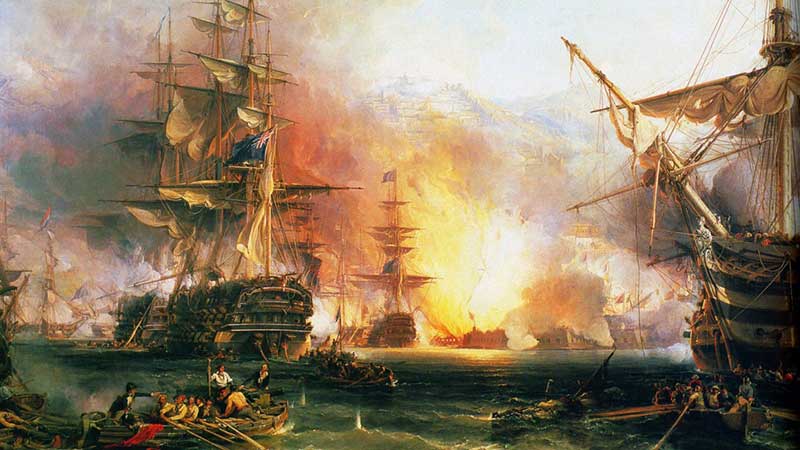
Chapter 33: The Semicircle of Echoes
The western cove of Sidi Abderrahman was a natural horseshoe of white sand,
dominated by fifty-foot cliffs of gray limestone. The cliffs were covered in a
dense, wild tangle of rosemary, dwarf palm, and ancient, gnarled olive trees
whose roots clung to the rock face like dry, brown fingers.
Below, the water of the cove was shallow and clear, the gentle summer surf
rolling onto the empty beach with a soft, rhythmic hiss.
General Loverdo's second division approached the cove in forty flat-bottomed
wooden boats, their oarsmen pulling hard against the light coastal current. The
soldiers—two thousand men of the 20th Regiment of the Line—sat
shoulder-to-shoulder, their muskets held upright between their knees, their
faces bright with a sudden, eager hope. They had heard the distant, thunderous
roar of the naval bombardment to the east, and they believed they had
successfully outflanked the "mysterious dunes" of the peninsula.
"The beach is clear!" a young lieutenant in the lead boat called out, his brass
telescope focused on the empty sand. "There are no trenches, and no guns! The
cove is ours!"
The lead boat touched the sand with a soft, wet scrape.
The lieutenant was the first to leap into the knee-deep water, his saber raised
to guide his men. "Forward, men of the Twentieth! For the King!"
He took three steps onto the wet sand.
CRACK.
The sharp, clean report of a Sabaa rifle rang out from the high cliffs above.
There was no smoke. No white cloud to reveal the position of the shooter. But
the French lieutenant was lifted off his feet, his saber spinning from his hand
as he fell backward into the shallow water, his blue coat turning rapidly dark
with blood.
"Ambuscade!" a sergeant screamed from the boat. "Get down!"
Before the soldiers could even react, the entire semicircle of the cliffs
erupted into a rolling, sharp cadence of rifle fire.
CRACK... CRACK... CRACK...
The acoustics of the horseshoe cove were devastating. The high limestone walls
did not merely release the sound; they reflected it, multiplying the sharp
detonations of the guncotton cartridges until the air was filled with a
continuous, confusing roar. Because there was no smoke to mark the muzzles, the
sound seemed to come from everywhere and nowhere at once—from the olive trees,
from the rocky crevices, and from the sky itself.
The French soldiers, trapped on the narrow strip of sand below, were completely
disoriented. They raised their Charlevilles, firing a frantic, ragged volley at
the high cliffs.
BOOM-BOOM-BOOM.
A massive cloud of thick, white sulfurous smoke erupted from the beach,
completely blinding the landing force. But their round lead balls did nothing
but chip the gray limestone forty feet below Yusuf's positions, their energy
spent, their trajectory erratic.
Worse, the French smoke cloud now served as a perfect, static target for the
marksmen above.
"Target the oarsmen!" Yusuf's voice called out from behind an ancient olive
tree, his Sabaa rifle aligned with the second boat. "Do not let them turn the
craft!"
The Zouaoua and the Khayala marksmen focused their fire. At eighty yards, the
accuracy of the Sabaa was absolute.
The oarsmen in the flat-boats were systematically picked off, their bodies
falling over the wooden sweeps, their blood staining the white oak of the oars.
Without oarsmen to hold them against the current, the heavy wooden boats lost
their steerage. They were caught by the surf, turning broadside—broaching—in the
shallow water.
"We are turning!" a French sergeant screamed as his boat was lifted by a wave
and slammed sideways into the sand. "We are taking on water!"
The second boat was struck by a third, the heavy wooden hulls colliding with a
wet, crushing thud that threw the heavily laden soldiers into the neck-deep
surf. Weighted down by their sixty-pound leather packs, their cartridges soaked
and useless, many of the soldiers struggled to stay afloat, their high leather
shakos floating away on the green water.
On the cliffs, the Zouaoua fired with a cold, tireless precision.
A Flissa marksman named Belkacem the Younger, who had spent his youth hunting
mountain sheep in the high snows, lay behind a juniper bush. He loaded and fired
with a steady, rhythmic cadence—crack... slide... load... click... crack—his
rifle producing nothing but a faint, blue-gray mist of steam that vanished
instantly in the sea-breeze.
With every shot, a French soldier on the beach fell, his blue coat turning dark
as he rolled into the red-stained foam.
General Loverdo, watching the disaster from his command boat three hundred yards
out, realized they had run into a second, even more terrifying trap. His men
were pinned down on a narrow strip of sand, under a continuous, high-precision
crossfire from an invisible enemy they could neither see nor shoot back at.
"Retreat!" Loverdo's voice roared through his brass speaking-trumpet. "Pull the
boats back! All boats, retreat!"
The oarsmen who were still unhurt backed water, their oars splashing frantically
as they pulled the remaining flat-boats away from the bloody sand of the cove.
They left behind twelve abandoned, broached craft, their hulls filled with water
and dead men, and more than eighty blue coats floating listlessly in the surf.
The second wave of the outflanking maneuver was utterly broken.
Yusuf walked back to the horse-lines behind the ridge, his Sabaa rifle on his
shoulder, his face smeared with a light layer of grease and charcoal.
Near the horses, a small, lead-lined wooden box had been mounted on a flat
stone—a portable telegraph junction box connected to the main buried wire that
ran to the fort.
He sat before the small brass key, his fingers pressing the lever to send his
report back to Amine at the main redoubt.
Click... clank... click.
The signal traveled through the two miles of sand and pine forest, reaching the
center redoubt in less than a millisecond.
Inside the redoubt, where the heavy naval shells of the French fleet were still
throwing geysers of dry sand into the air, the needle of Amine's receiver
clicked.
Amine read the translation.
"The western cove is secure, Sidi," Meziane said, his hand writing down the
numbers. "Yusuf reports: Loverdo's division has retreated to the ships. Twelve
boats abandoned. Eighty enemy dead. Our forces are unhurt. The wire is holding."
Amine pressed his key, his signal to Yusuf short and final: Hold the position.
The fleet will not try the cove again today. The main fight is still here.
He looked back through his telescope at the flagship Provence.
The naval bombardment had been running for three hours, but the sand wall was
still standing—a low, flat, sand-filled ridge of dunes that had absorbed more
than three hundred heavy iron shells without a single breach.
The French fleet was running out of ammunition, their white smoke clouds turning
the bay into a foggy wilderness of gray mist and sulfur. And on the decks of the
transports, the third division under General de Neuilly was preparing to land.
"The tide is turning, Yusuf," Amine said, his voice quiet as he looked at the
distant ships. "The French have spent their thunder. Now, they must face our
steel."
End of Chapter