Chapter 36: The Capitulation on the Sand
The dawn of June 15, 1830, rose over the bay of Sidi Fredj with a flat, gray
light that did nothing to pierce the heavy smell of sulfur and damp rot.
General de Bourmont stood on the highest mound of the western dunes, his hand
gripping the brass guard of his sword so tightly that his knuckles were white.
His eyes, sunken and bloodshot from a sleepless night of terror, stared at the
narrow neck of the peninsula.
Around him, his staff officers stood in a silent, exhausted circle, their
uniforms covered in the black soot of the night's blind volleys, their faces
pale with a quiet, professional despair.
"We have two choices, General," Admiral Duperré said, his voice carrying the
heavy, flat tone of a man who knew his career was finished. "We can attempt to
evacuate the troops to the ships. But with the wind blowing hard from the north,
it will take twenty hours to load the flat-boats under the fire of their rifled
cannons. We will lose half the army in the surf. Or... we can charge."
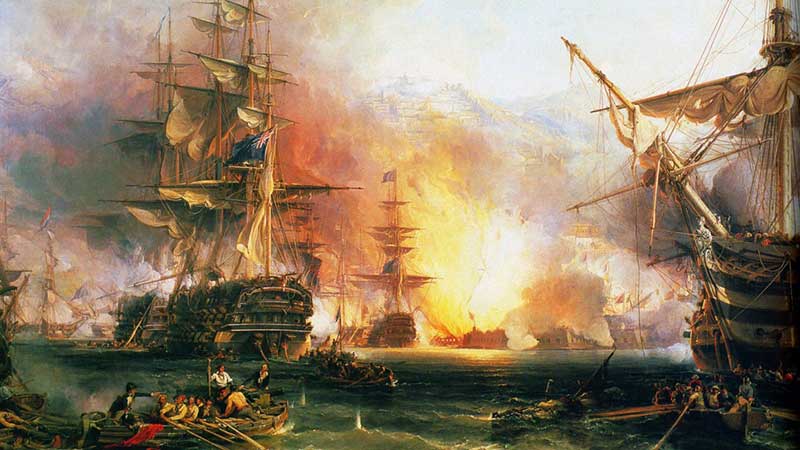
Bourmont turned his head slowly toward the outer bay, where the ninety-gun
flagship Provence rode the dark waves.
He knew, with a terrifying, political certainty, that to retreat now was the end
of his life. If he returned to France with fifteen hundred dead and the army of
the King routed by a "barbarian prince," Charles X's ministry would fall within
the week, and he would face a military court for treason and incompetence. He
had to win. He had to break the sand wall, even if it cost him the lives of
every soldier in the division.
"We will charge," Bourmont declared, his voice dry and hard. "We will commit the
entire force. Neuilly's division, Loverdo's, and the remains of Berthezène's.
Twenty thousand men will advance in three parallel columns. We will overwhelm
their wall by sheer weight of numbers. If they have five hundred rifles, they
cannot shoot twenty thousand men before we reach their bayonets."
He drew his sword, the steel reflecting the cold gray of the morning. "To arms!
Forward, for the King!"
Inside the center redoubt, Amine watched the French preparation through his
telescope.
The French army was forming into three massive, deep columns of attack, their
fronts forty men wide, their ranks packed tight on the narrow sand of the neck.
It was a spectacular, desperate show of military force. Twenty thousand bayonets
rose into the morning light like a forest of steel needles, and the drums of
forty regiments began their driving, thunderous beat—the pas de charge.
"They are throwing everything into the scale, Sidi," Yusuf said, his hand steady
on the key of his field telegraph. "They are going to try to crush us by
weight."
"A massed column on a narrow neck of sand is a mathematical target, Yusuf,"
Amine said, his voice calm, flat, and carrying the absolute authority of an
engineer. "They have forgotten that the narrower the path, the more concentrated
the fire. Tell the Zilzal crews to load the double-canister. We do not fire at
their front; we fire along the length of their columns."
He pressed his telegraph key, sending his final, decisive command to the
Staoueli forest camp.
Khayala, the signal read. Deploy to the flanks. Cut off their retreat to the
beach.
The French charge began at seven o'clock in the morning.
With a roar of "Vive le Roi!" that drowned out the sound of the surf, twenty
thousand French soldiers broke into a run, their heavy boots kicking up a
massive, blinding cloud of white sand as they charged the silent dunes.
The Zilzal cannons opened fire.
BOOM.
The six gold-bronze rifled guns, loaded with double-canister—one hundred and
sixty heavy lead balls in each charge—fired in a continuous, alternating
cadence.
The effect was not a battle; it was a physical harvest.
The storm of lead balls, traveling at eleven hundred feet per second, did not
hit a flat wall of soldiers; it ripped through the entire length of the deep,
packed columns. The heavy lead tore through three, four, five men in a single
line, shattering bones, severing limbs, and turning the clean blue wool of the
uniforms into a shredded mass of red and gray.
The front of the columns vanished in a fraction of a second. But the pressure of
the twenty thousand men behind them was so immense that the survivors were
forced forward, stepping over the bodies of their comrades, their eyes blind
with the sand dust and the smoke.
"Forward!" the French officers screamed, their swords waving through the fog.
"Storm the ridge!"
They reached three hundred yards... then two hundred.
"Fire!" Yusuf's voice roared.
The three hundred Zouaoua marksmen, their Sabaa rifles loaded with the smokeless
guncotton cartridges, opened fire from the trenches.
Crack-crack-crack-clack.
The fire was a continuous, rolling, high-precision storm. Because there was no
smoke to blind them, the Zouaoua picked off the French officers with absolute,
terrifying accuracy. Every gold epaulet, every tall leather shako, every
sergeant-major who stood up to guide the men was dropped instantly.
The French command structure was systematically decapitated within five minutes
of the charge.
Still, the sheer mass of the French infantry pressed on, their bayonets fixed,
their faces white with the desperation of men who knew there was no safety
behind them. They reached one hundred yards... the front ranks were beginning to
scramble up the sandy slope of the breastwork.
"Now!" Amine's voice carried through the telegraph wire.
From the pine forests of the flanks, the fifty Khayala dragoons erupted onto the
beach.
They did not ride in a traditional cavalry charge. They rode to the flanks of
the French columns, dismounted in their four-man Rabaa squads, and opened a
devastating, rapid crossfire with their Sabaa rifles from two hundred yards.
It was the final, decisive blow.
The French columns, caught in a three-way crossfire of high-precision rifles and
double-canister artillery on a narrow strip of sand, completely broke.
The men in the center of the columns, unable to advance against the wall of sand
and unable to retreat against the barricade of their own dead, turned and fled
toward the sea. The charge dissolved into a panicked, screaming mob of twenty
thousand men who scrambled over each other to reach the flat-boats, their
weapons discarded, their drums silent, their officers dead or captured.
General de Bourmont himself was thrown from his horse as a Zilzal shell exploded
ten paces away. He lay on the wet sand of the beach, his green silk sash covered
in mud, his face white as he stared at the disaster of his army.
He looked up.
Standing over him was Yusuf, his Sabaa rifle pointed at his chest, flanked by
ten gray-clad Zouaoua marksmen whose faces were completely calm and
professional.
"The day is ours, General," Yusuf said, his voice quiet, his hand resting on his
saber. "Your fleet cannot save you. Your army is broken. Sign the paper."
The capitulation of the French expeditionary force was signed at noon on
June 15, 1830, on the very sand of the Sidi Fredj beach where they had landed
twenty-four hours before.
The table was a simple wooden drum-head, set up in front of the center redoubt,
under the shadow of the gold-bronze Zilzal cannons.
Amine sat on a simple camp chair, his gray wool burnous clean, his hand holding
a silver pen. Across the table sat General de Bourmont, his hands trembling, his
uniform torn and stained with the salt-mud of the beach.
"The terms are simple, General," Amine said, his voice flat, steady, and
carrying the absolute authority of a sovereign. "Your thirty-seven thousand men
will surrender all their weapons, their ammunition, and their field artillery to
the League of the Atlas. Your ships—the warships and the transports—will remain
in the harbor of Algiers under our custody until we have inspected them."
Bourmont swallowed hard, his eyes fixed on the silver pen in Amine's hand. "And
my men? Will you murder them on this sand?"
"We are not pirates, General," Amine said. "We are a civilized state. Your
soldiers will be marched to the interior under our guard. They will be paid a
fair wage of silver to work on our new macadam roads, our mines, and our
foundries until your king—or whatever government replaces him in Paris—has paid
the fourteen million francs of the grain debt, with thirty years of interest."
He slid the parchment across the drum-head.
"Sign."
General de Bourmont took the pen. With a slow, heavy hand, he pressed his
signature and his seal onto the Treaty of Sidi Fredj.
The first major invasion of Algiers was over. The French armada had been broken
on the sand, not by the summer storms, but by the steel, the science, and the
unity of the League of the Atlas.
Amine stood up, looking out over the bay where the great French warships sat
silent, their white flags of surrender flying from their masts.
The first step was complete. Algeria was united under his hand, his father's old
court was obsolete, and his own independent sovereignty was absolute. The
kingdom was born, and the road to its future was open.
"Yusuf," Amine said, looking toward the north. "Send the telegraph to Algiers.
Tell my father that the French are no longer on our beach. And tell him... that
I am coming to the capital."
End of Chapter