Chapter 37: The Scepter of the Lion
The entrance into the city of Algiers on June 20, 1830, was not a triumph of the
old Ottoman style. There were no severed heads carried on Janissary spears, no
half-naked prisoners dragged in chains through the dust, and no frantic, chaotic
firing of brass muskets into the air.
It was a display of silent, mechanical discipline that left the city in a state
of quiet, breathless awe.
Amine rode near the head of the column on his black stallion, dressed in a
simple, unornamented gray wool burnous over a dark silk vest. Behind him, the
fifty Khayala dragoons sat their horses in perfect, double-filed lines, their
Sabaa rifles held upright in their leather scabbards, their movements
coordinated and silent.
Behind them marched the three hundred Zouaoua of the League, their gray wool
uniforms clean and uniform, their boots clicking on the paved stones of the Bab
Azzoun gate with a steady, clockwork-like rhythm—clack, clack, clack—that
sounded like the heartbeat of a single, massive machine.
The streets of the lower city were packed to the roofs. Thousands of Algiers
citizens—Moorish merchants, Kouloughlis, Jewish tradesmen, and Kabyle
laborers—stood in silent, packed ranks along the whitewashed walls.
As Amine's column passed, the silence broke into a sudden, roaring wave of
sound.
Women leaned from the high wooden lattices of the houses, throwing rosewater and
handfuls of sweet-smelling jasmine flowers over the soldiers, while the men
shouted the ancient Berber and Arabic cries of victory. They had spent three
years under the suffocating grip of the French blockade, their families hungry,
their businesses ruined, waiting for the day when the French fleet would land
and burn their homes.
Now, the "mad prince" from the mountains had returned, and behind his column,
under the guard of his gray-clad riflemen, walked General de Bourmont and fifty
elite officers of the French Royal Guard, their swords gone, their heads bowed
in surrender.
The French army had not just been beaten; it had been captured.
The meeting in the grand Diwan of the Casbah was a moment of profound,
historical transition.
The high-vaulted hall of white marble columns and glazed blue tiles was packed
with the members of the Diwan—the Janissary Aga, the Muftis, the treasury
clerks, and the representatives of the Kouloughli guilds. They stood in silent,
nervous groups, their eyes watching Amine as he stepped through the cedar doors,
flanked by Yusuf and Lounes.
At the far end of the hall, raised on his low marble dais, sat Hussein Dey.
The old man looked smaller than Amine remembered. His white beard was long and
untrimmed, his face creased with the deep, dark hollows of three years of
exhaustion and isolation. But as he looked at his younger son, his eyes were
bright, filled with a sudden, overwhelming mixture of tears, pride, and relief.
Amine walked to the center of the hall, stopping ten paces from the dais. He did
not bow low, nor did he wait for the master of ceremonies to announce his name.
He stood straight, his hand resting on the hilt of his silver-mounted dagger.
"Father," Amine said, his voice quiet but carrying clearly through the marble
hall. "The beach of Sidi Fredj is empty. The French fleet has raised its
anchors, and General de Bourmont has signed the capitulation of his army. I have
brought his sword to your feet."
He signaled Yusuf, who stepped forward and laid the gold-hilted sword of the
French Minister of War onto the marble steps of the dais.
A collective gasp ran through the Diwan. Ibrahim Pasha, who stood by the side of
the throne, his face white as clay, took a step back, his hand trembling as he
stared at the sword.
Hussein Dey stood up. His movements were slow, his knees shaking under his
fur-trimmed kaftan, but he did not use his staff. He walked down the marble
steps of the dais until he stood directly in front of his son.
He reached out, his hand touching Amine's shoulder, his fingers tracing the
rough wool of his burnous. A single, large tear rolled down his gray beard.
"You have saved us, my son," the Dey whispered, his voice cracking with emotion.
"You have tided over the storm that I could not face. I gave you a barren
mountain and a ruined fort, and you... you have returned with the scepter of
this land."
He turned to the silent assembly of the Diwan, his voice rising with a sudden,
unexpected strength.
"I am an old man," Hussein Dey declared, his hand rising to touch the sovereign
signet ring on his finger—the seal of the Dey of Algiers. "I have ruled this
land through twelve years of war, of plague, and of blockade. But my time has
passed. The future of this country belongs to the steel and the science of my
son."
He slid the heavy gold ring from his finger and pressed it into Amine's hand,
his fingers closing his son's hand around the metal.
"Before this Diwan, and before the Creator, I abdicate my authority. I name my
son, Amine ibn Hussein, as the absolute sovereign of this land. From this hour,
his word is our law."
The neutralization of Ibrahim Pasha was executed with the same cold, civilized
efficiency that characterized Amine's military operations.
As the Diwan began to disperse, Yusuf and four Zouaoua marksmen stepped into the
path of the Janissary Aga.
Ibrahim Pasha froze, his hand instinctively going to his yatagan sword.
"Amine... you dare to arrest me? I am the commander of the Janissaries! The
Yoldach will burn this Casbah if you touch my cloak!"
Amine walked over to him, his face calm, his hand holding a small leather ledger
he had taken from Omer Beylerbey's tax-convoy.
"The Janissaries will not burn the Casbah, Ibrahim," Amine said, his voice low
and level. "Because I have already paid them their arrears in pure Sabaa Silver.
They have seen the weight of my coins, and they have seen the length of my
rifles. They no longer answer to your gold."
He opened the ledger.
"This is the record of your trade with the French merchants of Marseille through
the port of Dellys during the height of the blockade. You were selling our grain
to the enemy's fleet while my father's people were starving in the lower city,
and you were pocketing the silver in your private bank at Tunis."
Ibrahim's face went translucent, his hand falling from his sword hilt.
"I am not going to execute you, Ibrahim," Amine said, closing the book. "I do
not want to stain my first day of rule with the blood of my family. You will be
placed on one of the captured French transports tonight, along with your wife
and your gold. You will sail for Constantinople, and you will never return to
this land. If you step onto our soil again... Yusuf will show you the reach of
his rifle."
Ibrahim Pasha did not answer. He bowed his head, his shoulders slumping as Yusuf
led him away through the side door of the hall, his power gone, his faction
neutralized without a single shot.
On the morning of June 22, 1830, Amine stood on the high stone balcony of the
Casbah, looking out over the city and the harbor.
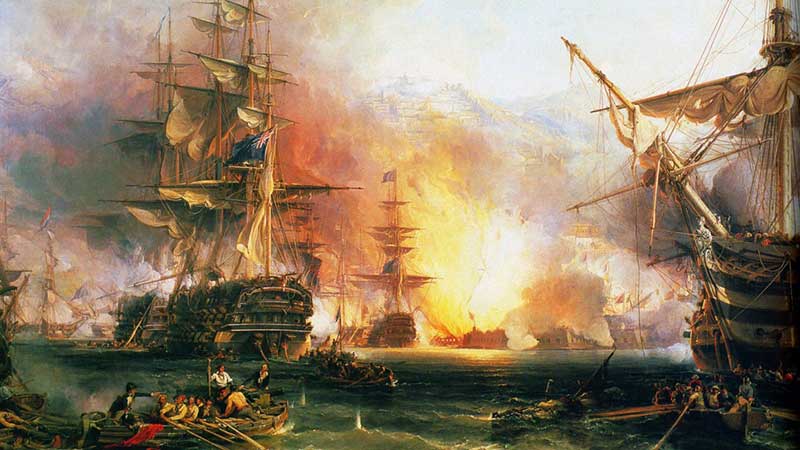
The harbor was a spectacular sight. The French warships—the ninety-gun Provence
and the frigates—rode the calm water of the bay, their white flags of surrender
flying beneath the new flag of the Algerian Empire: a dark green field carrying
the gold emblem of the Sabaa lion.
A grand assembly of the tribal elders of the Atlas, the Moorish scholars of the
city, and the Kouloughli guild-masters stood in the courtyard below, their eyes
fixed on the young sovereign.
Amine stepped to the marble railing.
"People of Algeria," Amine's voice carried clearly through the quiet of the
morning. "For three centuries, this land has been a Regency of the Ottoman
Sultan. We have paid our tribute to Constantinople, and we have accepted their
Janissaries as our rulers. But Constantinople is weak. They could not protect
our coasts from the French, and they could not feed our children during the
blockade."
He raised his hand, the gold signet ring of his father flashing in the sun.
"From this hour, the Regency is dead. The tribute to the Sublime Porte is
abolished. We are no longer a province of an empire; we are our own empire—the
Sultanate of Algeria. We will maintain a diplomatic respect for the Caliph in
Constantinople, but our sovereignty is absolute. We bow to no one but the
Creator."
He gestured toward the ships in the harbor.
"We have broken the finest armada of Europe on our sand. We have shown them that
our science is as long as our road, and our steel is as hard as our mountain.
But this is only the beginning. We are going to build railways across our
plains; we will build steamships for our seas; and we will expand our borders
until our power is felt across the entire continent of Africa."
He looked at the crowd.
"The age of iron has begun. Let us write our history."
The crowd below broke into a sudden, roaring wave of sound—the shouting of
thousands of free men, their voices carrying the name of the Lion across the
white roofs of the Casbah to the blue waters of the Mediterranean.
The Algerian Empire was born. Amine was its absolute ruler, and the road to its
industrial future was open.
End of Chapter