Chapter 32: The Cushion of Sand
Aboard the ninety-gun French ship of the line Provence, Admiral Guy-Victor
Duperré stood on the quarterdeck, his gold-rimmed spyglass focused on the narrow
neck of the Sidi Fredj peninsula. His face, weathered by forty years of sea-salt
and gunpowder, was frozen in a look of stunned, cold disbelief.
Beside him, General de Bourmont, the Minister of War and overall commander of
the expedition, paced the deck, his gloved hands clenched behind his back so
tightly that the leather seam of his left glove had split.
"Six hundred men," Bourmont said, his voice a low, vibrating hiss of fury. "The
entire vanguard of Berthezène's division... broken in less than twenty minutes.
By what? By a hidden trench of sand and a few gold-bronze guns that we did not
even know existed? Admiral, your charts assured me this beach was empty!"
"It was empty, General," Duperré said, not lowering his glass. "My scouts mapped
this bay two weeks ago. There was nothing on that neck but dry sand and
sea-grass. Whoever built that wall did so in the dark of last night. And those
guns... they are not the heavy, obsolete bronze pieces of the Algiers harbor.
They are rifled. They fire exploding shells with a precision that is...
impossible."
He turned to Bourmont, his eyes dark with the heavy realization of a
professional sailor. "If we land the second division under Loverdo without
clearing that neck, we are sending them to a slaughter. We must use the
broadsides."
"Then do it, Admiral," Bourmont said, his voice flat and hard. "Bring the ships
of the line into the bay. Pulverize those dunes. I want that sand wall turned
into a smoking ditch before the midday tide."
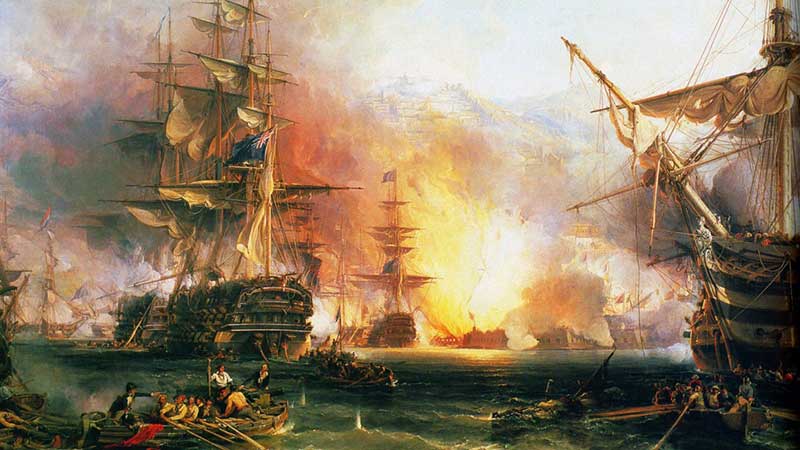
At ten o'clock in the morning, the French fleet began its response.
Four massive seventy-four-gun ships of the line, led by the Provence, and six
heavy frigates drew closer to the shore, their iron anchors dropping into the
shallow, green water of the bay, less than a thousand yards from the peninsula.
Through his telescope behind the center redoubt, Amine watched the warships
turn, their long, black hulls presenting their broadsides to the sand wall.
"Cover!" Amine's voice carried through the telegraph wire to the lookout post,
and then down the line of trenches. "Get down into the deep trenches! Cover your
heads!"
The Zouaoua marksmen, their Sabaa rifles held tight against their chests, slid
down from the breastworks into the narrow, deep-cut trenches they had dug behind
the sand-filled gabions. They lay flat on their stomachs, their faces pressed
into their wool cloaks, their ears covered by their hands.
A second later, the world dissolved into a hell of iron and fire.
BOOM-BOOM-BOOM-BOOM.
The broadsides of the French fleet opened fire in a continuous, rolling roar
that was louder than any thunder the mountains of Hamza had ever produced. The
sound was a solid, physical force that shook the very water of the bay and made
the limestone foundations of the old fort vibrate like a struck bell.
More than two hundred heavy naval guns—thirty-six-pounders and
twenty-four-pounders—fired simultaneously.
The sky above the peninsula was filled with the screaming, high-pitched whistle
of hundreds of heavy iron balls tearing through the air.
THUMP. THUMP. THUMP.
The impact was immense.
A thirty-six-pounder solid iron ball, traveling at twelve hundred feet per
second, struck the center of the sand wall with terrifying kinetic energy. But
there was no shattering of stone. There was no shower of lethal, razor-sharp
masonry fragments.
The sand did its work.
The iron ball buried itself deep into the sand-filled wooden gabion. The dry,
compacted sand absorbed the energy instantly, distributing the force of the blow
across millions of tiny, crystalline grains. The gabion bulged, the willow laths
creaking under the strain, but it did not split. The iron ball remained trapped
inside the wood and sand, stopped dead within three feet of its impact.
Another ball, a twenty-four-pounder, struck the sloping sand breastwork behind
the first line. It threw a massive, twenty-foot geyser of dry sand and sea-grass
into the air, but the explosion of the sand did nothing but cascade harmlessly
over the heads of the Zouaoua huddling in the deep trenches below.
Amine lay in the center redoubt, the dust falling over his gray burnous like a
fine gray powder, his face calm, his breathing steady. He felt the heavy,
rhythmic vibration of the soil as the iron balls struck the dunes, his mind
analyzing the structural resilience of the sand wall.
The physics are holding, Amine calculated, his hand steady on his pocket-watch.
Sand is a non-Newtonian fluid under high-velocity impact. It is the perfect
armor. In two hours of this bombardment, they will burn ten tons of powder and
achieve nothing but a flat ridge of dust.
During the height of the bombardment, the copper needle of the telegraph in the
redoubt began to click.
Click... clink... click.
Amine reached out, his fingers wiping a layer of white sand dust from the glass
case of the receiver. He read the needle's deflections.
"Sidi," Meziane's signal from the fort's lookout post read. "The French
transports are moving. Loverdo's second division is lowering their flat-boats.
They are heading west, toward the shallow cove of Sidi Abderrahman, two miles
down the beach. They are trying to bypass the neck."
Amine's fingers tightened on his brass key. He tapped his response instantly,
the electric current traveling through the buried copper wire, protected from
the naval shells by two feet of damp sand.
Deploy the Khayala to the western cove, Amine signaled to the staging camp in
the Staoueli forest. Take thirty Zouaoua. Position them in the olive groves
above the cove. Use the guncotton. Do not let them establish a second beachhead.
In the deep shadow of the Staoueli cork-oak forest, Yusuf received the signal.
"To horse!" Yusuf's voice roared, his saber flashing in the dim green light of
the canopy.
The fifty Khayala riders swung into their saddles, their movements rapid and
disciplined. Behind them, thirty Zouaoua marksmen slung their Sabaa rifles over
their shoulders, climbing onto the rear of the horsemen's saddles.
They broke into a gallop, the horses' hooves muffled by the soft earth of the
forest path as they hit the western road.
Because they had the macadam road, they covered the two miles to the western
cove in less than eight minutes, arriving at the high, rocky ridges above the
beach of Sidi Abderrahman long before the first French flat-boat had even
reached the shallow water.
Yusuf dismounted, his men sliding from the saddles to take their positions
behind the ancient olive trees and the thick juniper bushes that lined the
cliffs.
Below them, forty French flat-boats, carrying two thousand men of the second
division, were rowing toward the shore, their oarsmen pulling hard against the
current, believing they had found an undefended, quiet cove to land.
Yusuf raised his Sabaa rifle, his eye aligning the brass V-notch with the chest
of the French lieutenant in the lead boat.
"Wait for the signal," Yusuf whispered to his men. "And remember... there must
be no smoke."
End of Chapter