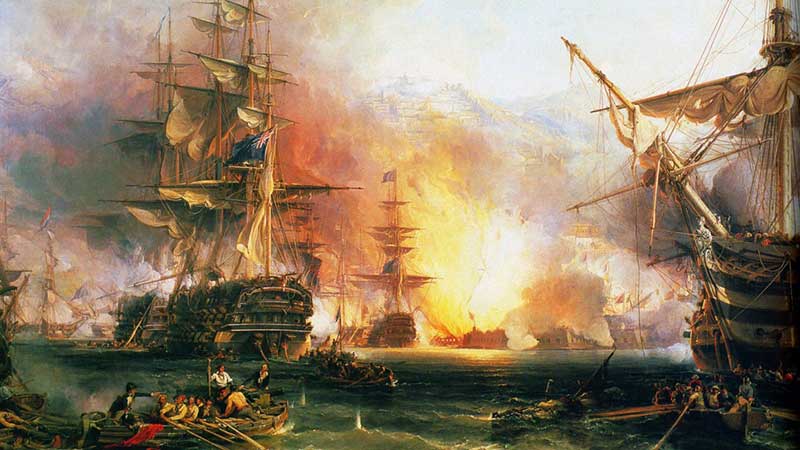
Chapter 43: The Iron Rib and the Screw
The maritime security of the Sultanate of Algeria could not rely forever on the
defensive sand wall of Sidi Fredj or the stationary batteries of the Casbah. A
nation that had to wait for the enemy on its own beaches was a nation that was
already half-conquered. To secure the Mediterranean and eventually carry his
power back to the shores of France, Amine needed an offensive navy.
In the spring of 1832, the Algiers Imperial Shipyard—established near the rocky
beach of Bab El Oued—was a forest of wooden scaffolding and smoking iron-kilns.
The old shipwrights, who had spent their lives building the wooden sailing
galleys and light chebecks of the corsair era, stood in silent, bewildered
groups before the massive blueprints Amine had pinned to the shipyard walls.
"A sailing ship of the line, Lounes," Amine said, his hand pointing to the hull
of the captured French warship Provence in the harbor, "is a relic of the past.
It is a prisoner of the wind. If the gale is against it, it cannot move; if the
sea is calm, it sits on the water like a floating log. We are going to build a
steam-powered corvette—the Al-Asad (The Lion)."
Lounes, his leather apron covered in the grease of the rolling mills, squinted
at the drawing of the ship's stern. "We have the steam engine, Sidi. We can
build a paddle-wheeler like the ones the English use on their rivers. But the
paddle-wheel is a massive, fragile target. If a single French shell strikes the
wooden wheel-house, the ship is paralyzed in the water."
"We are not going to use paddle-wheels, Lounes," Amine said. "We are going to
use a screw propeller."
He traced the shape of a multi-bladed bronze screw on the drawing.
"The propeller will be mounted at the very rear of the ship, completely
submerged under the water, behind the rudder. No enemy shell can reach it, and
it will not interfere with the clean, streamlined shape of the hull. It will
push the ship through the water with twice the force of a paddle-wheel, moving
directly against the wind and the tide."
He pointed to the most difficult mechanical detail of the design: the stern
gland.
"To turn this screw, we must run a solid steel shaft from the engine room,
through the wooden hull, out into the sea. But how do we do this without the
water rushing into the ship through the shaft-hole?"
Lounes rubbed his bald head. "If the hole is tight, the friction of the spinning
shaft will burn the wood. If it is loose, the ship will sink."
"We will build a stuffing box," Amine explained, showing him a detail of the
brass gland. "A heavy brass sleeve, bolted to the interior stern-post of the
hull. Inside the sleeve, around the spinning shaft, we will pack several layers
of thick hemp rope that have been boiled in a mixture of tallow and graphite
powder. A heavy brass gland-ring will be screwed down into the sleeve,
compressing the greasy hemp against the shaft."
He tapped the drawing.
"The compressed, greasy hemp will create a perfect, watertight seal. The grease
will lubricate the spinning shaft, preventing any friction heat, while the water
pressure of the sea will only force the packing tighter against the sleeve. It
is a simple, robust solution that will keep the hold dry, even when the shaft is
spinning at one hundred revolutions a minute."
It was the classic stuffing box—a critical detail of marine engineering that
would not be standardized in Europe for another decade, but which Amine's modern
mind deployed with absolute certainty.
The construction of the Al-Asad was a monument to the integration of their new
industries.
The skeleton of the ship was not built of wood alone. While the outer planking
was made of three-inch-thick, seasoned Kabyle oak, the internal ribs of the hull
were made of heavy, cast-iron frames—iron ribs—which Amine had cast at the Hamza
foundries.
This composite construction—iron-ribbed and wood-planked—was vastly superior to
traditional wooden ships. It allowed the hull to be lighter, stronger, and more
spacious, providing the room needed to mount the heavy steam boilers and the
marine engine deep in the hold.
The engine itself was a direct-acting, horizontal two-cylinder marine steam
engine.
Unlike the tall land engine they had built for the workshops, which stood four
meters high, the marine engine was designed to lie flat on the bottom of the
hold, completely below the ship's waterline. This was a critical tactical
parameter; by placing the boilers and the cylinders deep in the ship's belly,
they were protected from any enemy artillery fire by the surrounding water and
the heavy oak of the hull.
"The armor is ready, Sidi," Yusuf said, pointing to the flat-bed wagons that had
just arrived from the Hamza rolling mills.
On the wagons lay sixty sheets of rolled, high-tensile wrought iron, each sheet
two inches thick, one meter wide, and three meters long.
"We will bolt these plates to the outside of the oak hull, along the waterline,"
Amine said. "An iron belt, extending from one meter above the water-line to one
meter below. It will protect the boilers and the engine room from any standard
French thirty-six-pounder solid shot. The balls will strike the iron belt,
flatten, and fall into the sea, without ever penetrating the oak."
It was the birth of the ironclad—a technology that would not dominate the navies
of the world until the battle of Hampton Roads in 1862, but which Amine was
introducing in 1832 on a compact, highly mobile scale.
The launch of the Al-Asad was scheduled for the first week of September 1832.
The shipyard was packed with thousands of spectators from Algiers and the
surrounding valleys. Even the Dey himself had ridden down from the Casbah, his
old eyes bright with a sudden, deep pride as he looked at the sleek, low-slung
corvette that sat on the wooden launching-ways.
The Al-Asad was seventy meters long, its hull painted a dark, slate-gray, its
low copper funnel rising from the center of the deck like a silent chimney. It
carried six of their gold-bronze Zilzal rifled cannons on its broadsides, and a
heavy, thirty-two-pounder pivot gun at the bow, capable of firing exploding
shells in a full circle.
"Release the triggers!" Yusuf's voice roared.
The shipwrights struck the heavy wooden dog-shores with their sledges.
The massive, iron-belted hull slid down the greased wooden ways. With a heavy,
thunderous SPLASH that threw a twenty-foot wave of green water onto the shipyard
walls, the Al-Asad hit the sea.
The ship rocked, balanced itself, and sat straight and true on the water, its
draft exactly as Amine had calculated—three meters to the top of the iron belt.
"Light the boilers!" Amine called from the deck.
Within thirty minutes, a thin, clean column of dark coal-smoke began to rise
from the copper funnel. The steam pressure in the boilers rose to sixty pounds,
and the horizontal cylinders in the hold began their deep, rhythmic, metallic
whoosh-thump.
Amine stood at the wooden wheel on the quarterdeck, his hand on the brass
steering-spindle.
"Engage the screw," Amine said.
The engineer in the hold turned the valve.
The massive brass stuffing box did its work. The three-bladed bronze propeller
began to spin under the water, leaving a clean, bubbling, white wake behind the
rudder.
Without a single sail raised, and without a single oar touching the water, the
forty-ton ironclad corvette moved smoothly out of the harbor basin, heading
directly into the teeth of the strong northern wind.
Chuff-chuff-chuff-chuff.
The ship accelerated, reaching a speed of ten knots within the first mile. It
carved through the green waves of the bay with a clean, effortless power, its
iron belt glittering in the sun like the scales of a great sea-dragon.
Three miles out, the French blockade frigate La Flore watched the performance
through its spyglasses.
Its captain, a veteran of the Nile, stood on his quarterdeck, his mouth open,
his glass shaking as he watched the low, gray, smoke-capped beast move directly
against the wind, completely indifferent to the sails of his own ship, which
were flapping listlessly in the calm air of the harbor.
He knew, with a sudden, chilling certainty, that his blockade was no longer a
shield. It was a prison.
Amine stood at the wheel of the Al-Asad, his face sprayed by the cool salt-mist
of the sea, his hand steady on the wood. The last piece of his defense was
complete. He had the land, the air, the road, the wire, and now, the sea.
The year of 1832 was passing, and his empire was ready to write its own destiny
on the waters of the Mediterranean.
End of Chapter