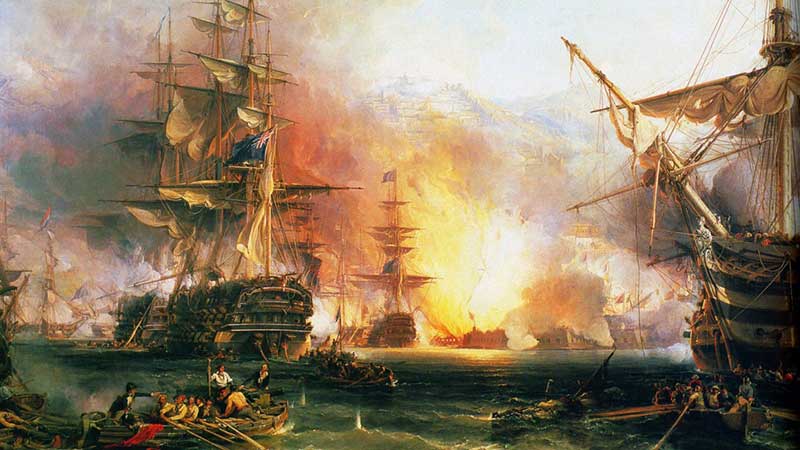
Chapter 44: The Shattered Shield
The blockade of Algiers had hung over the capital since June 1827 like a slow,
suffocating disease. Even after the disaster at Sidi Fredj, the French Ministry
of Marine in Toulon had maintained a loose squadron of frigates and corvettes
five miles off the coast, tasked with intercepting any merchant vessels and
monitoring the "mad prince's" activities.
On the morning of September 15, 1832, three French warships cruised the blue
waters of the outer bay under a light, easterly breeze.
The flagship of the blockading squadron was La Flore, a modern forty-four-gun
frigate under the command of Captain Jean-Luc Duval—a nephew of the insulted
consul Pierre Deval. Flanking her were two twenty-four-gun corvettes, La Vestale
and Le Griffon. Their sails were white against the blue sky, their long iron
guns primed, their crews confident in their three centuries of naval dominance.
Through his brass pocket telescope on the quarterdeck of Al-Asad, Amine watched
them from inside the harbor basin.
"The wind is from the east, Yusuf," Amine said, his voice quiet and steady as
the horizontal steam engine in the hold below began its deep, rhythmic
whoosh-thump. "That means La Flore must tack repeatedly to stand across our
harbor mouth. But we are completely indifferent to the wind. We will steam
directly out, meet them at twelve hundred yards, and lift the blockade."
Lounes stood by the engine-hatch, his hands covered in graphite-grease, his face
hot from the boilers below. "The steam pressure is at sixty-five pounds, Sidi.
The stuffing box is holding; there is not a drop of water in the shaft tunnel."
"Engage the screw," Amine said.
The three-bladed bronze propeller began to spin. The forty-ton ironclad corvette
glided out from the bab-el-Oued wharf, its low copper funnel spitting a thin,
clean column of dark coal-smoke that drifted back over the white roofs of the
Casbah.
On the quarterdeck of La Flore, Captain Duval raised his spyglass. He saw the
low, slate-gray ship emerging from the harbor, its decks flat and free of any
rigging, its copper funnel rising like a chimney from the center.
"A steam-vessel," Duval muttered, a cold sneer of professional contempt on his
lips. "The prince has built a toy. He thinks he can run his river-boat against a
frigate of the King. Clear the decks for action! We will take her broadside-to,
disable her paddle-boxes, and drag her to Toulon."
"But Captain," his lieutenant said, pointing to his glass. "She has no
paddle-boxes. There are no wheels on her sides."
Duval frowned, his glass scanning the dark gray hull. "No wheels? Then how does
she move against the wind? It is impossible."
"She has a chimney, Captain," the lieutenant said, his voice trembling slightly.
"And she is moving at ten knots... directly into the teeth of the breeze."
"It does not matter!" Duval barked. "She is made of wood. Bring the ship to the
wind! Prepare the port batteries!"
The tactical engagement that followed was a clean, mathematical demonstration of
the absolute obsolescence of the wooden sailing navy.
La Flore and her twin corvettes maneuvered to bring their broadsides to bear,
their long sails straining under the wind as they formed a classic line of
battle. But because they were dependent on the breeze, their movements were
slow, predictable, and clumsy compared to the high mobility of the screw-driven
ironclad.
Amine turned the wooden wheel of Al-Asad, positioning his ship at a distance of
twelve hundred yards—well within the accurate range of his Zilzal rifled guns,
but beyond the effective reach of the French smoothbore eighteen-pounders.
"Bring her broadside-on, Yusuf," Amine said.
The corvette swung, its low, gray hull presenting its three port-holes to La
Flore.
Captain Duval saw the maneuver. "Fire!" he screamed.
The port batteries of La Flore opened fire in a thunderous, rolling roar that
shook the sea. Twenty-two heavy iron balls tore through the air, their black
powder smoke creating a massive white cloud that completely obscured the
frigate.
CLANG. CLANG. METALLIC THUD.
Ten of the French solid iron balls struck the waterline of Al-Asad.
Inside the engine-room, Lounes and his crew heard a series of terrifying,
deafening clangs that sounded like a giant striking an anvil with a massive
hammer. The ship heeled slightly to the port side under the immense kinetic
energy of the blows.
But there was no splintering of wood. There was no rush of water into the hold.
The two-inch-thick rolled iron belt had done its work. The French round shot,
fired from smoothbore barrels at twelve hundred yards, had flattened against the
hard wrought-iron plates like soft lead, bouncing harmlessly off the metal and
splashing into the sea. The three-inch-thick Kabyle oak hull beneath the iron
plates was completely untouched.
"The armor is holding, Lounes!" Amine's voice carried down the copper
speaking-tube.
"Praise be to the Creator!" Lounes's voice returned, hoarse and triumphant over
the roar of the cylinders. "The boilers are dry!"
"Yusuf," Amine said, his eye fixed on La Flore through his telescope. "The
French have spent their first broadside. They are reloading, and they are blind
in their own smoke. Target their mainmast with the bow pivot gun."
Yusuf stood by the massive, thirty-two-pounder rifled Zilzal gun on the bow
platform. He adjusted the brass elevating screw, aligning the sights with the
tall pine mast of La Flore that rose above the white gunpowder smoke.
He pulled the lanyard.
BOOM.
The heavy rifled gun fired with a sharp, cracking roar.
At twelve hundred yards, the cylindrical-conical iron shell, spinning down the
rifled bore, reached the French frigate in less than three seconds.
It struck the mainmast of La Flore ten feet above the deck.
The copper safety pin of the percussion fuze sheared on impact. The internal
plunger struck the cap, and the bursting charge of glazed powder exploded inside
the mast.
BANG.
The explosion was catastrophic. The massive pine mast, nearly two feet thick,
was torn in half by the blast. The upper rigging—thousands of yards of heavy
canvas sails, miles of hemp rope, and the heavy wooden yards—collapsed onto the
deck in a chaotic, crushing ruin of wood and rope, crushing several sailors and
trapping the gun crews under a mountain of wet canvas.
La Flore was paralyzed, her sails dragging in the water, her guns silent under
the wreckage.
"The second corvette!" Yusuf called out, his crew already reloading the pivot
gun with a fresh shell.
Al-Asad steamed in a slow, elegant circle around the crippled flagship, her
horizontal engine humming with a smooth, effortless power. Her three broadside
Zilzal guns opened fire, targeting the twenty-four-gun corvette Le Griffon,
which was attempting to tack to the west to escape.
BOOM... BOOM... BOOM...
The exploding shells tore through the wooden sides of Le Griffon like paper.
Unlike solid shot, which merely punched clean holes in the timber, the exploding
shells detonated inside the wooden cabins, turning the dry oak walls into
millions of razor-sharp splinters that swept across the decks, killing every man
in their path. Fires broke out instantly in the ship's galley and the sail-room,
the thick black smoke of burning tar rising into the sky.
Within ten minutes, Le Griffon was sinking, her stern-post shattered by a shell,
her crew scrambling into the water as the sea rushed into her hold.
The remaining corvette, La Vestale, seeing her flagship paralyzed and her sister
ship sinking, did not wait. Her captain turned his ship to the north, crowding
every inch of sail onto his masts as he fled at a frantic gallop toward the
safety of Toulon, carrying the news of the disaster back to the French Ministry
of Marine.
By noon, the battle was over.
La Flore lay still on the calm water, her mainmast gone, her decks covered in
soot and blood, a white flag of surrender flying from her remaining fore-post.
Amine steamed Al-Asad to within fifty paces of the crippled frigate. He stood on
his quarterdeck, his hands tucked into his sleeves, his face sprayed by the cool
salt-mist of the sea.
The French sailors who stood along the rails of La Flore watched him approach
with a look of profound, superstitious terror. They looked at the low, gray,
iron-belted hull of the corvette, which had taken ten of their heavy shots
without a single scratch; they looked at the smoking copper funnel; and they
looked at the clean gold-bronze of the Zilzal guns.
Captain Jean-Luc Duval stood by his shattered wheel-house, his sword held out on
his palms, his face white with a mixture of pain and humiliation.
"The blockade is lifted, Captain Duval," Amine said, his voice quiet, flat, and
carrying clearly over the water in the sudden silence of the harbor. "You may
take your wounded men and your remaining sails. But you will tell your King that
the sea of Algiers no longer belongs to his frigates. From this day, the
Mediterranean has a new master."
As the shattered remains of the French blockading squadron slowly turned and
limped toward the north, the bells of the Algiers mosques began to ring, and the
white roofs of the Casbah were filled with thousands of citizens who shouted
their triumph into the warm autumn air.
The five-year blockade of Algiers was broken.
The sea was open. The first modern steam warship in the world had swept the old
wooden navy from its path, and the Sultanate of Algeria was now free to trade,
to expand, and to write its own destiny on the waters of the world.
End of Chapter